Instead of paintings or statues, Istanbul's mosques are decorated with writing, tiles and pattern, and much of what looks like ornament is actually text you can read. Calligraphy turns the names of God, the Prophet and verses of the Qur'an into architecture, while İznik tiles and geometric designs add colour and rhythm. Learn to recognise a handful of inscriptions and motifs, and every mosque you visit becomes far easier to understand.
On this page7
Why words instead of pictures?
Islamic tradition avoids depicting people and animals in places of worship. The idea, rooted in several hadith (sayings of the Prophet), is to stay far from anything that could resemble idol worship and to keep the worshipper's attention on God alone. This is not a blanket ban on images in Islamic culture: Ottoman manuscripts, for example, contain beautiful miniature paintings. But inside a mosque, the language of art is script, plants and geometry.
As a result, writing rose to become the highest of the arts. The Ottomans called it hüsn-i hat, “beautiful line”. A calligrapher (hattat) trained for years under a master before receiving an icazet, a kind of diploma allowing them to sign their work. The calligraphy tradition of Türkiye is recognised on UNESCO's list of Intangible Cultural Heritage.
The giant roundels of Hagia Sophia
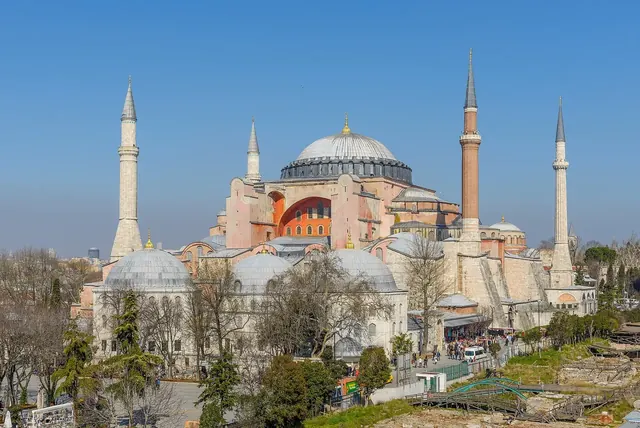
Walk into Hagia Sophia and you cannot miss the huge round panels, gold letters on a green ground, hanging high in the main hall. The eight roundels were written by the great 19th-century calligrapher Kazasker Mustafa İzzet Efendi and installed during the major restoration of 1847–1849 under Sultan Abdülmecid. They are often said to measure around seven and a half metres across, which places them among the largest calligraphic panels in the Islamic world.
They carry eight names: Allah, Muhammad, the first four caliphs Abu Bakr, Umar, Uthman and Ali, and the Prophet's grandsons Hasan and Husayn. According to most sources, the verse from the chapter of Light in the centre of the dome is by the same hand. Byzantine mosaics and Ottoman calligraphy sharing a single dome sum up the building's layered, fifteen-century history better than any label.
A cheat sheet of common inscriptions
Mosque inscriptions are almost always in Arabic. Large panels are usually in the bold, flowing celî sülüs (monumental thuluth) script; you may also spot angular Kufic and the rounder naskh used in books. When letters are stacked and interlaced into a single composition, calligraphers call it istif. Here is what to look for:
- The Basmala: “Bismillahirrahmanirrahim”, “In the name of God, the Most Gracious, the Most Merciful”. Often above doors and at the start of long inscriptions.
- The Shahada (Kelime-i Tevhid): “La ilahe illallah, Muhammedun Rasulullah”, “There is no god but God, and Muhammad is His messenger”, the core statement of Islamic faith.
- Ayat al-Kursi (the Throne Verse): verse 255 of the chapter al-Baqara, describing God's majesty, often running as a long band around a dome or above windows.
- The Light Verse: verse 35 of the chapter an-Nur, beginning “God is the Light of the heavens and the earth”. Because of its imagery of light, it is a favourite for domes.
- The mihrab verse: above the prayer niche of many Ottoman mosques you will find verse 37 of Al Imran, which mentions Zechariah entering the mihrab.
- Signature and date: check the lower corner of big panels for the calligrapher's signature and a Hijri date.
İznik tiles: Rüstem Pasha, Sokollu and the Blue Mosque
The 16th century was the golden age of İznik ceramics. Cobalt blue, turquoise, green and, from around the 1550s, a raised tomato or coral red are its signature colours. The motifs are tulips, carnations, hyacinths, roses, pomegranate blossoms and cypress trees, often read as a reflection of the gardens of paradise.
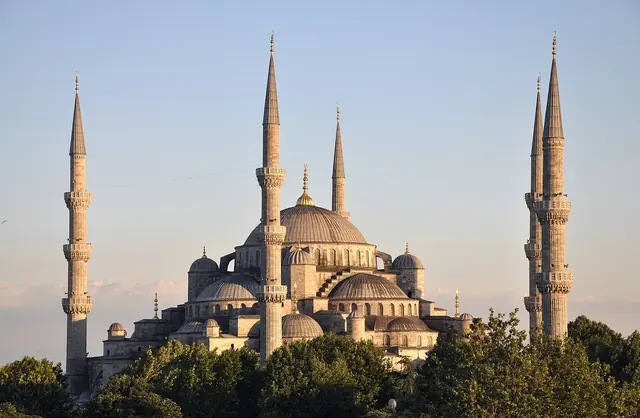
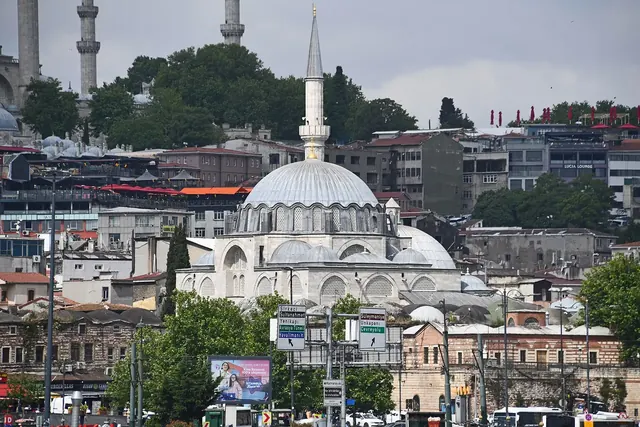
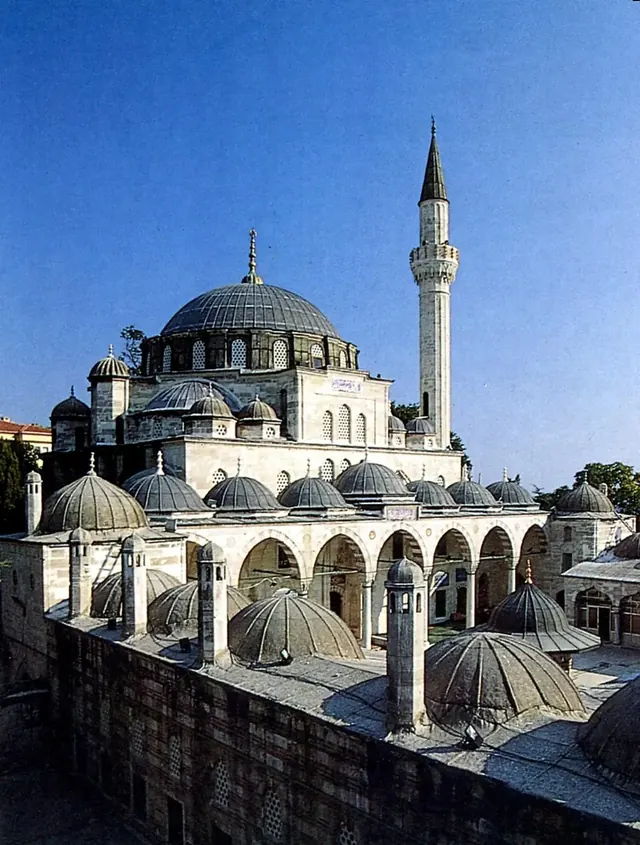
The Rüstem Pasha Mosque near the Spice Bazaar is covered almost entirely in İznik tiles and has the richest variety of designs in the city. Just steps from our hotel, the Sokollu Mehmed Pasha Mosque pairs superb tiles on its qibla wall with bands of calligraphy; according to tradition, small fragments said to come from the Black Stone of the Kaaba are set above its door, mihrab and minbar. And it is the interior tiles, reportedly more than twenty thousand of them, that gave the Blue Mosque its popular name.
Patterns without end: geometry and flowers
On doors, pulpits, window grilles and ceilings you will see interlocking stars and polygons. These geometric patterns are built so that they could, in principle, continue forever in every direction, and many writers connect this with ideas of God's unity and infinity. Curling tendrils and split leaves known as rumi, and stylised blossoms known as hatayi, form the basic vocabulary of painted and tiled decoration.
The tulip has a special place in Ottoman art. Written in Ottoman script, the word lale uses the same letters as Allah, a coincidence often mentioned as one reason for its popularity.
Tezhip and ebru: the arts of the book
Tezhip (illumination) frames manuscripts of the Qur'an and calligraphic panels with gold leaf and fine painted ornament. Ebru is the art of paper marbling: colours are sprinkled onto thickened water, swirled into patterns and transferred onto a sheet of paper. It was traditionally used for book covers and the borders of calligraphy panels, and Turkish ebru was inscribed on UNESCO's intangible heritage list in 2014.
To see these arts up close, visit the Museum of Turkish and Islamic Arts on the Hippodrome, the treasures of Topkapı Palace and the calligraphy collection of the Sakıp Sabancı Museum on the Bosphorus.
A short walking route to “read” from our hotel
- Sokollu Mehmed Pasha Mosque: study how tiles and inscriptions work together on the qibla wall.
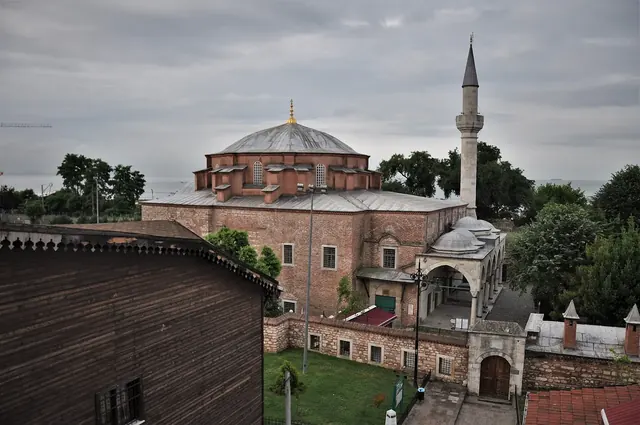
- Little Hagia Sophia Mosque: Byzantine column capitals next to Ottoman inscriptions in a calm, simple interior.
- The Blue Mosque: the inscription bands in the domes and half-domes, and the tiles on the upper level.
- Hagia Sophia: the giant roundels and the Light Verse in the dome.
- Museum of Turkish and Islamic Arts: Qur'an manuscripts, illumination and calligraphy.
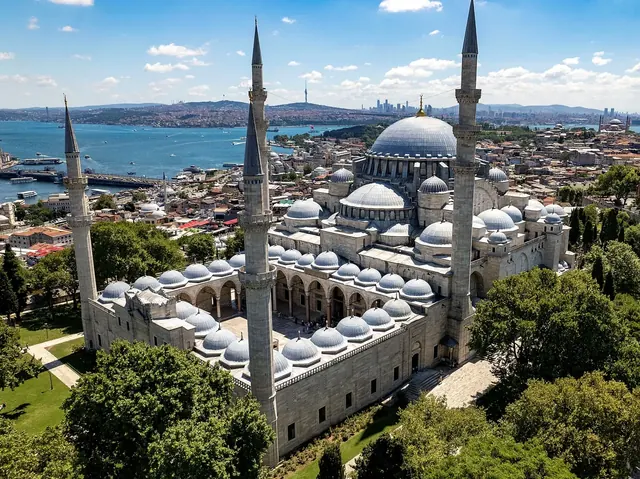
Visit mosques outside prayer times and follow the dress code; our mosque etiquette guide has the details. To understand the mihrab, minbar and dome themselves, read what is a mosque, and for more architecture try our Mimar Sinan route.
Frequently asked questions
Why are there no pictures of people in mosques?
Islamic tradition avoids depicting people and animals in places of worship, to stay clear of anything resembling idol worship and to keep the focus on God. Mosques are therefore decorated with calligraphy, plant motifs and geometric patterns.
What is written on the big round panels in Hagia Sophia?
The names Allah and Muhammad, the four caliphs Abu Bakr, Umar, Uthman and Ali, and the Prophet's grandsons Hasan and Husayn. They were written by Kazasker Mustafa İzzet Efendi in the mid-19th century.
Where can I see the best İznik tiles in Istanbul?
The Rüstem Pasha Mosque has the richest variety of designs. The Sokollu Mehmed Pasha Mosque and the Blue Mosque are also outstanding and easy to combine with a walk around Sultanahmet.
Can I try calligraphy or marbling myself?
Yes, short introductory workshops in calligraphy and ebru are offered in Istanbul. Ask at our front desk for current options.