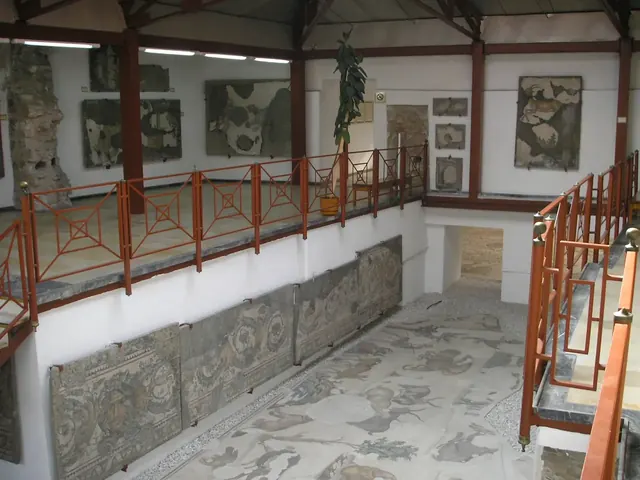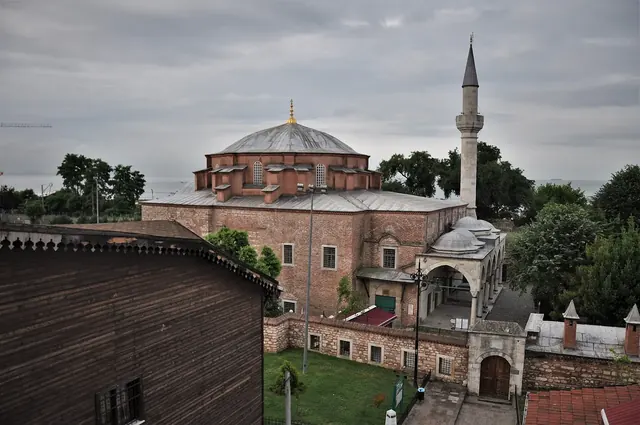
Little Hagia Sophia is a Byzantine church built by Emperor Justinian I and Empress Theodora between 527 and 536, dedicated to Saints Sergius and Bacchus, and today a working mosque. It sits on the quiet slope of Sultanahmet that runs down to the Sea of Marmara, just a few streets from Hagia Sophia. With its octagonal dome, a Greek inscription running around the nave and a leafy courtyard, it offers a genuinely Byzantine experience without the crowds.
On this page5
The dome that came before Hagia Sophia
The church was built right next to the Palace of Hormisdas, where Justinian lived before he became emperor. According to tradition, the young Justinian was once accused of plotting against his uncle Justin I and escaped execution after Saints Sergius and Bacchus appeared to the emperor in a dream; the church is often described as his thank-offering. Because work began a few years before the present Hagia Sophia and the building carries a similar dome, locals came to call it “Little Hagia Sophia”.
For a long time it was described as a rehearsal for the great dome. Many historians now think the two building sites ran largely in parallel. The plan is an octagon set inside an irregular rectangle: eight piers carry a pumpkin-style ribbed dome that gives the interior a gentle, rippling quality, while the columns on both levels alternate between green and reddish marble.
From church to mosque: the Ottoman layer
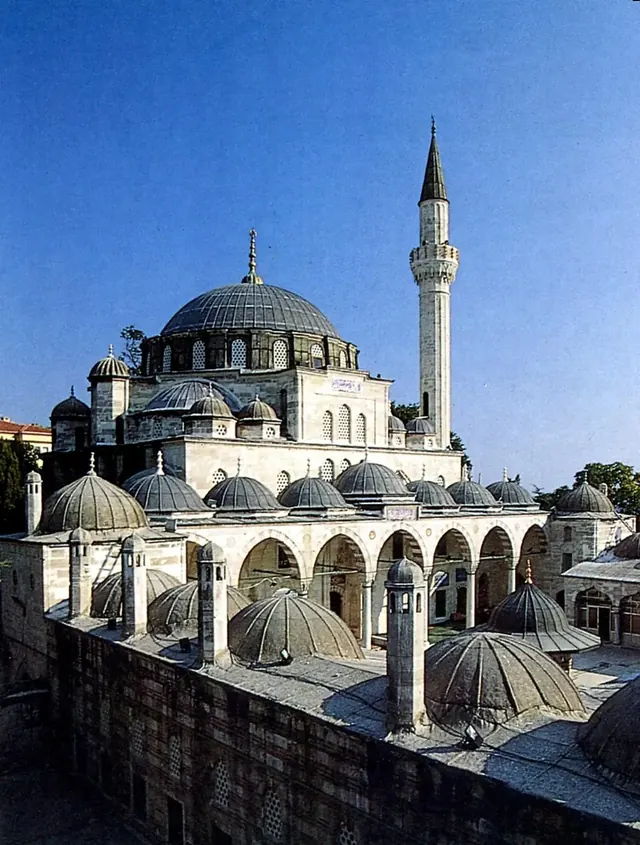
In the early 16th century, during the reign of Bayezid II, the building was converted into a mosque by Hüseyin Ağa, chief of the palace's Gate of Felicity. He added the minaret, the portico and the madrasa cells that frame the courtyard, and his tomb still stands near the entrance. Earthquakes and damp took their toll over the centuries, and the railway laid right alongside in the late 19th century brought constant vibration. A thorough restoration completed in the mid-2000s gave the interior back its light and coherence.
The courtyard is where the neighbourhood breathes: plane-tree shade, a simple ablution fountain and neighbours sipping tea in front of the old madrasa rooms. Standing here in the backstreets of Küçük Ayasofya and Kadırga, it is hard to believe the tour-group crowds are only a few hundred metres away.
What to look for inside
- The Greek inscription: a long verse inscription carved along the entablature above the ground-floor columns names Justinian, Theodora and Saint Sergius — one of the finest Byzantine inscriptions in the city.
- Monogrammed capitals: look closely at the delicately carved capitals for the interlaced monograms of the imperial couple.
- The ribbed dome: stand in the centre and look up to see how light from the windows makes the dome feel almost weightless.
- The galleries: the best viewpoint for taking in the octagonal plan, although access is not always open.
- Hüseyin Ağa's tomb and the madrasa courtyard: spend a few minutes here to understand the building's Ottoman chapter.
Etiquette and the best time to visit
Entry is free, and because this is an active mosque, visits pause briefly during the five daily prayers. Women are expected to cover their hair, everyone should cover shoulders and knees, and shoes come off at the door. Our mosque etiquette guide covers the details. Early morning or the calm stretch of the late afternoon is when soft light fills the dome and you may have the place almost to yourself.
Getting there from Sareban Hotel
This is our closest historic neighbour: from Cinci Meydanı Street it is a short stroll of a few streets towards the sea, and the minaret appears as soon as you turn the corner. Afterwards, walk uphill to the Sokollu Mehmed Pasha Mosque or downhill to the Kennedy Avenue seaside promenade. You can see the route on our location page.
Frequently asked questions
Is there an entrance fee for Little Hagia Sophia?
No, entry is free. As a working mosque it closes to visitors for a short time during each prayer.
Is Little Hagia Sophia the same as Hagia Sophia?
No. It is a separate, much smaller building a few hundred metres south of Hagia Sophia, near the Marmara shore. It was built as the Church of Saints Sergius and Bacchus and got its nickname from its Hagia Sophia-like dome.
How long do I need?
Thirty to forty minutes is enough for the interior and courtyard; allow a little longer if you want to sit and soak up the neighbourhood atmosphere.
Is it suitable for children?
Yes. The courtyard is calm and safe, and inside you simply need to keep your voices down. The short visit makes it an easy stop for families.