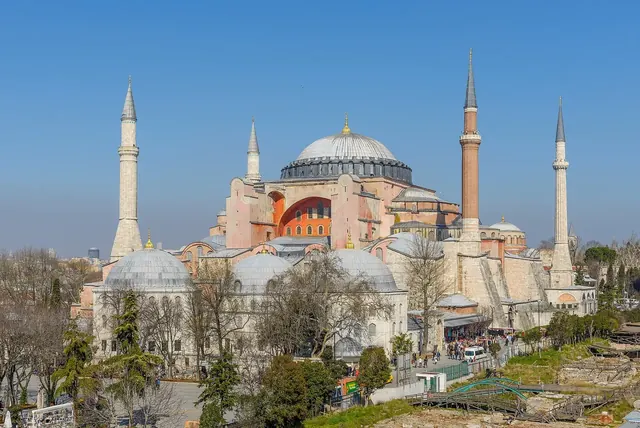
Hagia Sophia is the great domed building Emperor Justinian I completed in 537, and today it is an active mosque officially called the Hagia Sophia Grand Mosque. It stands at the northeastern end of Sultanahmet Square, directly facing the Blue Mosque. Few places anywhere let you read fifteen centuries of history in one interior: Byzantine mosaics, Ottoman calligraphy and a dome that went unmatched for almost a thousand years.
On this page5
A dome built in five years
The building you see is the third church on this spot. The first was a 4th-century basilica; its successor, rebuilt under Theodosius II, burned down during the Nika riots of 532. Justinian immediately hired two scholars rather than ordinary builders, Anthemius of Tralles and Isidore of Miletus, and the vast new church was consecrated in 537.
The original dome collapsed after earthquakes in 558 and was rebuilt with a steeper profile by Isidore the Younger. Forty windows ring its base, so the shell seems to float on light; the historian Procopius wrote that it looked as if it hung from heaven on a golden chain. At roughly 31 metres across, it crowned one of the largest enclosed spaces on earth for centuries.
Church, mosque, museum and mosque again
After the Ottoman conquest in 1453, Sultan Mehmed II converted the church into a mosque. Minarets, a mihrab and a minbar followed, and the great architect Sinan added supporting buttresses and designed the tomb of Selim II in the grounds. In 1847–1849 the Swiss-Italian Fossati brothers carried out a major restoration for Sultan Abdülmecid, and the giant calligraphic roundels you see today were painted by the master calligrapher Kazasker Mustafa İzzet Efendi.
The building became a museum in 1934–1935 and was reconverted into a mosque in July 2020. Since January 2024 the ground floor has been reserved for worship and is free, while foreign visitors use a separate entrance and buy a ticket to tour the upper galleries. Rules have changed several times in recent years, so check official announcements shortly before you go.
What to look for in the galleries
- The Deesis mosaic: A 13th-century panel in the south gallery showing Christ between the Virgin Mary and John the Baptist. Its softly shaded faces are Byzantine art at its finest.
- The Empress Zoe panel: Christ flanked by Constantine IX Monomachos and Empress Zoe. The emperor's face and name were later altered; look for the patched inscription.
- The Komnenos panel: John II Komnenos and Empress Irene beside the Virgin and Child, Irene with her striking pale braids.
- The Marble Door: Stone panels carved to imitate a wooden door; legend says its two leaves represent heaven and hell.
- Viking graffiti: Runes scratched into a gallery parapet, thought to be the work of a Varangian guard; the readable part gives the name Halfdan.
- The view down: From the gallery you see the eight huge roundels and the two Hellenistic marble urns brought from Pergamon under Murad III.
Visiting rules and dress code
Women should cover their hair and everyone should cover shoulders and knees; shorts are not appropriate for men either. Visitor flow can pause or slow around prayer times, especially at Friday midday prayer. Our mosque etiquette guide covers the details.
In the garden on the south side, the tiled tombs of Selim II, Murad III and Mehmed III and an elegant 18th-century ablution fountain offer a quiet break from the crowds.
Getting there from Sareban Hotel
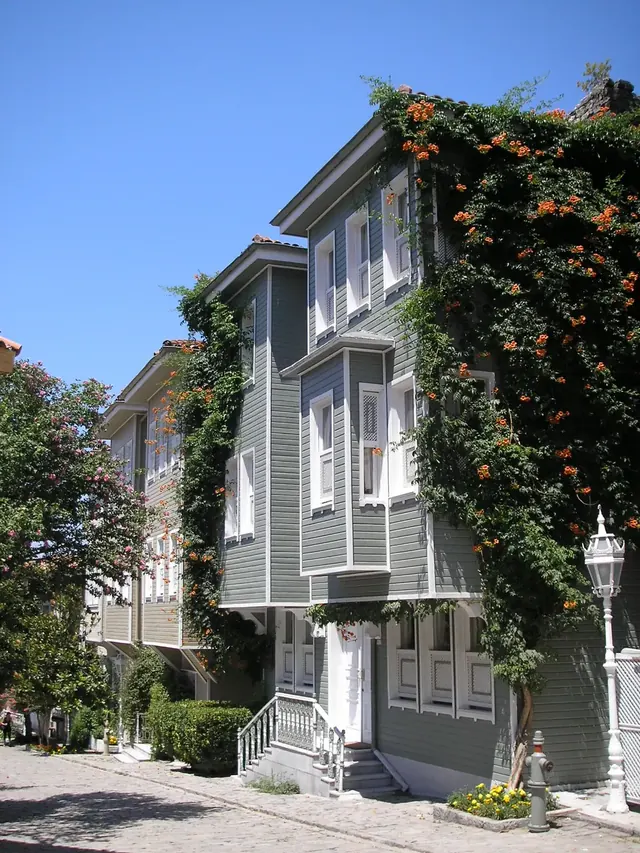
From our hotel in Küçük Ayasofya it is an easy walk: head up the slope past the Sokollu Mehmed Pasha Mosque, cross the length of the Hippodrome, and Hagia Sophia rises straight ahead. The Sultanahmet stop on the T1 tram line is right beside it if you prefer to ride.
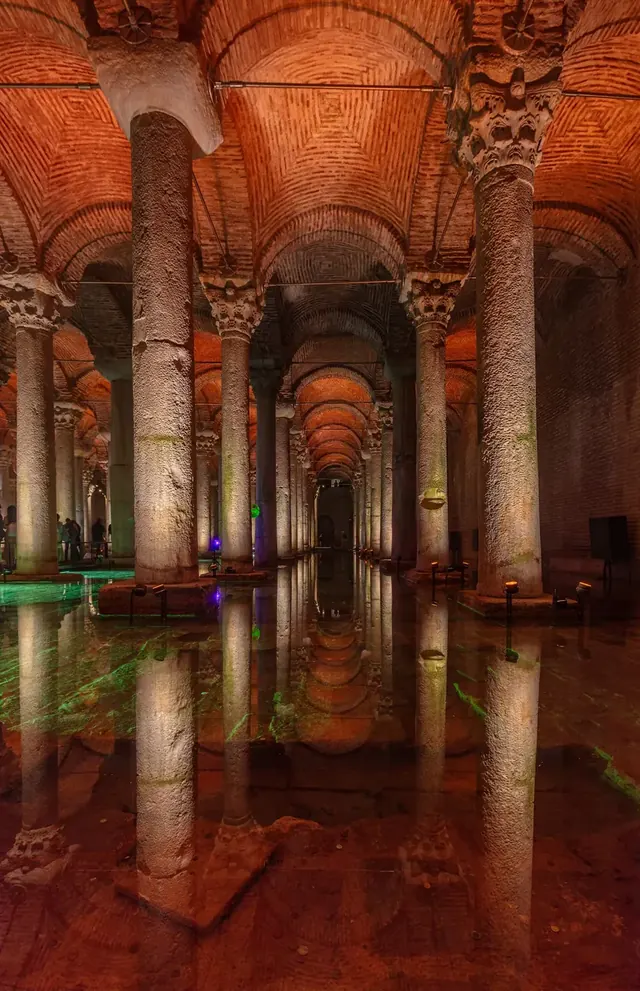
Afterwards, the Basilica Cistern is on the opposite corner, and the main gate of Topkapı Palace sits just behind the building at the start of Soğukçeşme Street.
Frequently asked questions
Do tourists have to pay to enter Hagia Sophia?
Yes. Since January 2024 foreign visitors enter through a separate entrance with a paid ticket and tour the upper galleries. The ground floor remains free for those coming to pray. Check the official website for the current fee.
Can you still see the mosaics now that it is a mosque?
Yes. The gallery mosaics, including the Deesis, Zoe and Komnenos panels, are on view. The apse mosaic of the Virgin and Child is screened by curtains or lighting during prayer times.
How long should I plan for Hagia Sophia?
About an hour covers the gallery route. Allow up to ninety minutes if you want to study the mosaics closely and visit the sultans' tombs in the garden.
Is Hagia Sophia suitable for young children?
Yes, but the galleries are reached by a long stone ramp and can get crowded. A baby carrier is far more practical than a stroller.