Salah, called namaz in Turkish, is the prayer Muslims perform five times a day at set times, facing Mecca, through a sequence of standing, bowing and prostrating. It is preceded by ablution and performed on a clean surface, usually a prayer rug. For anyone exploring Istanbul, it is also the rhythm that decides when the great mosques are open to visitors.
On this page6
Salah and namaz: what the words mean
The Qur'anic word is salah, carrying the sense of prayer and connection. Turks call it namaz, a Persian word used across the Turkish, Iranian and South Asian worlds.
Prayer is one of the five pillars of Islam, obligatory for every adult Muslim of sound mind. It is described as a direct conversation between the believer and God, so it needs no priest or intermediary and can be performed alone as well as in a group.
Five prayers and their units
The five prayers fall at dawn, midday, afternoon, sunset and night, each announced by the call to prayer. A prayer time lasts until the next one begins, so Muslims need not pray the minute the adhan sounds, only within that window.
Each prayer is made of units called rakat (rekât). A rakat is one cycle of standing recitation, bowing and two prostrations. The obligatory part is 2 units at dawn, 4 at midday, 4 in the afternoon, 3 at sunset and 4 at night. In Hanafi practice, voluntary units following the Prophet's habit are added, plus the witr prayer after the night prayer.
The postures of prayer
If you watch a prayer, you will see these positions repeat in every unit:
- Takbir: the prayer opens with hands raised and the words “Allahu akbar”; from here on, the worshipper sets the outside world aside.
- Kıyam (standing): hands folded, the worshipper recites the opening chapter of the Qur'an, al-Fatiha, and a short passage in Arabic.
- Rükû (bowing): bending from the waist with hands on knees and back straight.
- Secde (prostration): forehead, nose, palms, knees and toes on the ground. There are two in every unit, and it is regarded as the most humble moment of the prayer.
- Sitting (ka'de): after every second unit and at the end, the worshipper kneels and recites set prayers.
- Salam: turning the head right, then left, saying “as-salamu alaykum wa rahmatullah” (peace and God's mercy be upon you) to close the prayer.
Ablution and the courtyard fountain
Before praying, Muslims perform ablution (abdest in Turkish, wudu in Arabic), washing certain parts of the body with clean water. It is both physical cleanliness and a way of preparing the mind. The fountains in mosque courtyards and the rows of taps along the outer walls exist for this. In Hanafi practice the sequence runs roughly as follows:
- Make the intention and wash the hands up to the wrists.
- Rinse the mouth and nose three times each.
- Wash the face from forehead to chin and ear to ear.
- Wash the arms up to and including the elbows, right then left.
- Wipe part of the head with a wet hand, then the ears and neck.
- Wash the feet up to and including the ankles, right then left.
Prayer rugs and the qibla
Prayer needs a clean surface. Mosque floors are fully carpeted; at home, at work or on the road Muslims unroll a small prayer rug (seccade). The arch woven into many rugs represents the mihrab, and the rug is laid with the arch pointing towards the qibla.
In a mosque the mihrab shows the direction. Elsewhere, people use a compass or a prayer-time app on their phone; from Istanbul, Mecca lies roughly south-east. For the parts of a mosque, see what is a mosque.
Practical tips for visitors
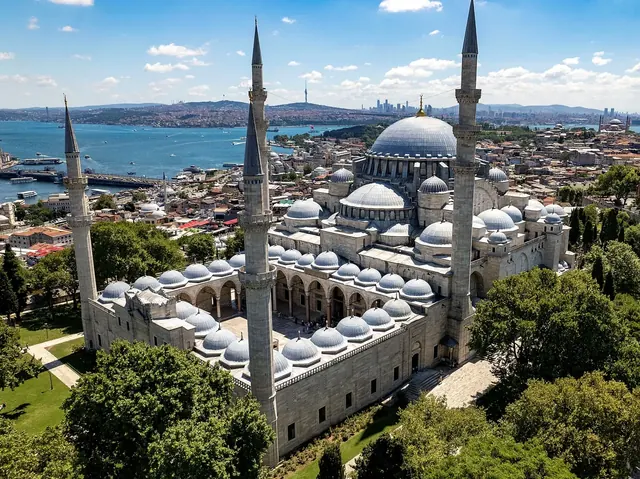
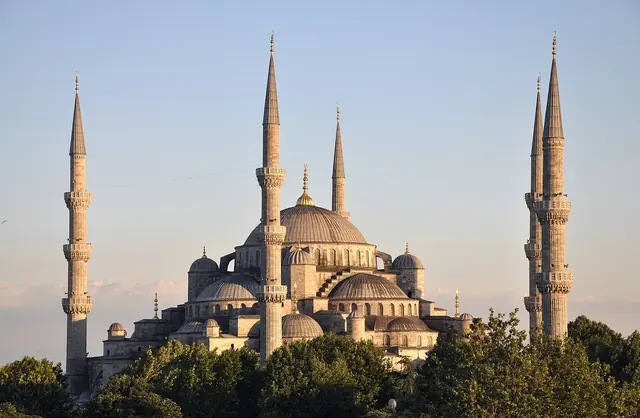
Big mosques such as the Blue Mosque and Süleymaniye close to sightseeing from a little before each prayer until it ends, usually for somewhere between half an hour and an hour, and for longer at Friday midday. Since prayer times shift daily, there is no fixed “opening hour”.
The easiest way to check the day's times is the official website or app of Türkiye's Presidency of Religious Affairs (Diyanet), or any prayer-time app set to Istanbul. Build your sightseeing around the five calls and you will rarely wait at a closed door.
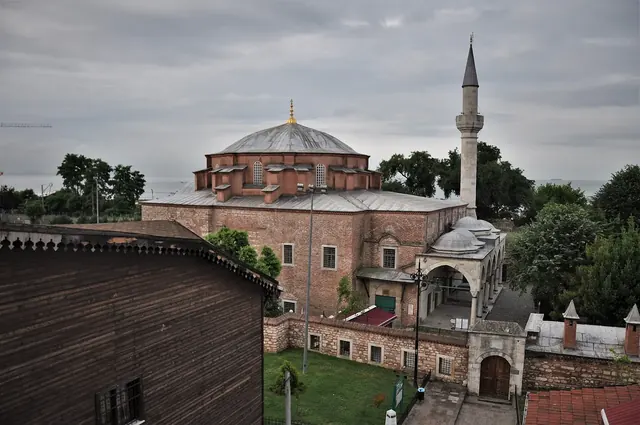
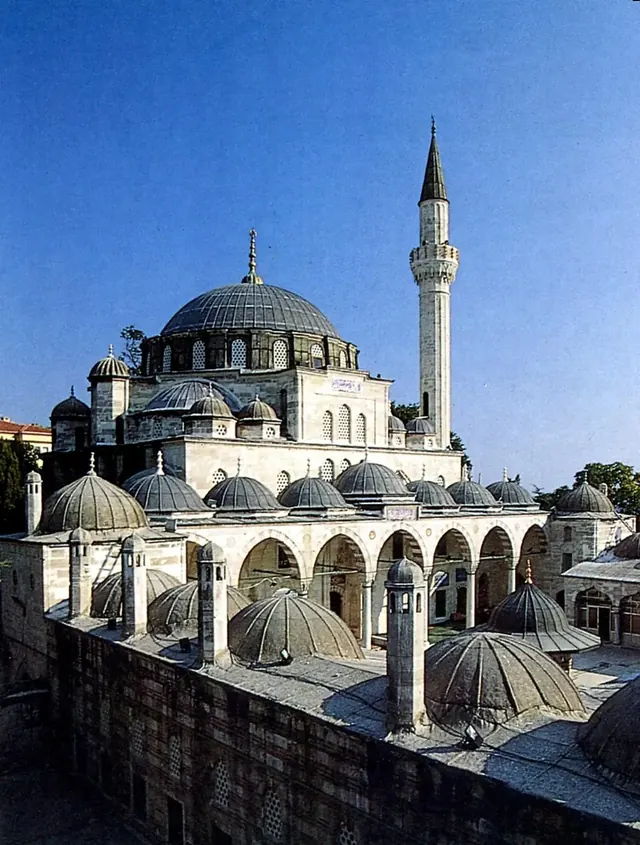
In smaller mosques such as Little Hagia Sophia and Sokullu Mehmet Pasha, you are often welcome to sit quietly at the back during prayer. Do not take photos, do not walk in front of worshippers, and follow any sign from the caretaker. Full guidance is in our mosque etiquette guide.
Frequently asked questions
Can non-Muslims watch the prayer?
Usually yes: sitting quietly at the back is welcome in most mosques. In the busiest mosques, visitor entry may be halted completely during prayer, so follow the staff's directions.
Do men and women pray together?
In the same mosque but in separate rows or areas: men in front, women behind, to the side or in an upper women's gallery. More on rows and congregation in our Friday prayer guide.
How do Muslim travellers pray?
In Hanafi law, a traveller going beyond a set distance and staying fewer than fifteen days in one place shortens the four-unit obligatory prayers to two. Practical tips for Muslim guests are in Istanbul for Muslim travellers.
Can I use Istanbul's mosques to pray if I am a Muslim visitor?
Of course. Every mosque is open for prayer at prayer times, and ablution facilities are at or near the courtyard. Tourist barriers apply only to sightseers, not to worshippers.