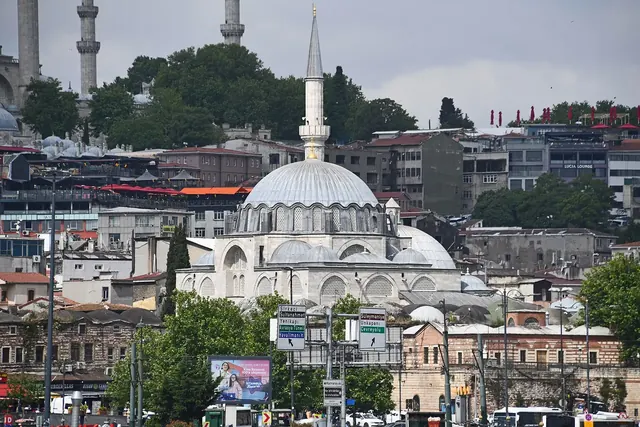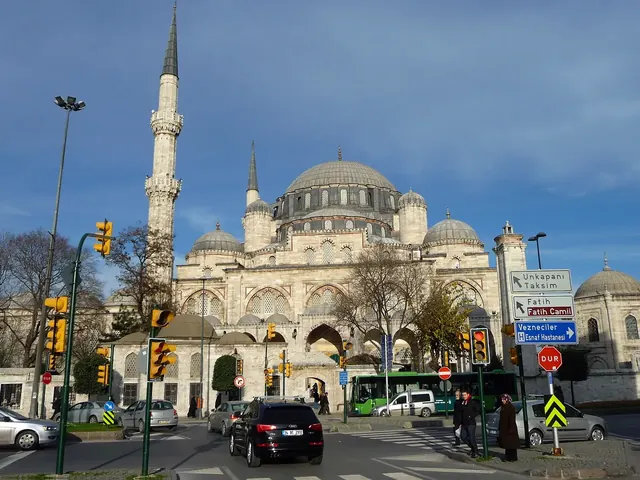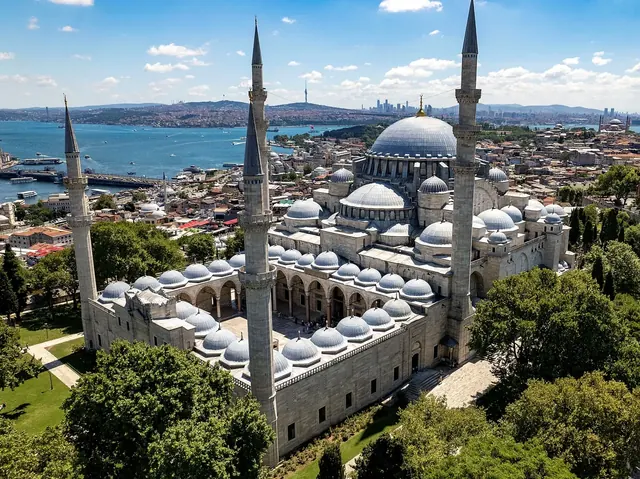
The Süleymaniye Mosque was built by Mimar Sinan for Suleiman the Magnificent between 1550 and 1557 on Istanbul's third hill, and it is widely seen as the high point of classical Ottoman architecture. Its silhouette dominates the Golden Horn, and with its colleges, hospital, library, the tombs of Suleiman and Hürrem Sultan and Sinan's own grave, the complex easily deserves half a day.
On this page6
Sinan's ‘journeyman’ work and an empire's signature
Sinan is said to have called the Şehzade Mosque his apprentice work, the Süleymaniye his journeyman work and the Selimiye in Edirne his masterpiece. Modest as that ranking sounds, no building expresses the power and order of Suleiman's reign more clearly. The dome rises to roughly 53 metres above the floor and measures about 26.5 metres across.
The plan refines the central dome and two semi-domes seen at Hagia Sophia and Beyazıt Mosque into a supremely balanced whole. The four massive piers that carry the dome are partly absorbed into the walls, so the interior feels open and uncluttered. The acoustics are famous too: the building is said to have been designed so that the imam's voice carried across the vast prayer hall without amplification.
Four minarets, ten balconies and fine detail
The four minarets at the corners of the courtyard carry ten balconies in total, often explained as a nod to Suleiman being the tenth Ottoman sultan. Inside, look for Iznik tiles on the prayer wall, stained-glass windows and inscriptions attributed to the great calligrapher Ahmed Karahisari and his pupil Hasan Çelebi.
According to a well-loved story, soot from thousands of oil lamps was drawn by the airflow into a small room above the entrance and collected to make ink. Whether or not every detail is true, it neatly sums up how Sinan treated architecture as a working system, not just a beautiful shell.
What to see
- The prayer hall: Pause at the entrance and take in how the dome seems to float.
- Tombs of Suleiman and Hürrem Sultan: In the garden behind the prayer wall; Suleiman's tomb has especially rich tile and painted decoration.
- Tomb of Mimar Sinan: A simple tomb of his own design on a small triangular plot at the corner of the complex.
- The Golden Horn terrace: Views over the Golden Horn, Galata and the mouth of the Bosphorus from the rear garden.
- The wider complex: Colleges, the former hospital and soup kitchen, and the Süleymaniye Library, known for its historic manuscripts.
Practical tips for your visit
Tourist visits pause during prayer times, so keep your plans flexible around Friday midday prayers in particular. Women should cover their hair, and everyone should cover shoulders and knees; our mosque etiquette guide explains the rest.
The rear garden becomes one of the most peaceful viewpoints in the city at sunset, which is why it features in our guide to sunset spots. The streets around the mosque are known for simple, long-established eateries serving white beans and rice, a tradition that grew up feeding the students of the old colleges and still makes a good local lunch.
Getting there from Sareban Hotel
From the hotel, walk along Divanyolu to Beyazıt Square, then follow the wall of Istanbul University north into the lanes that climb to Süleymaniye. To shorten the walk, take the T1 tram to Beyazıt-Kapalıçarşı. On the way back, you can head downhill towards the Golden Horn, visit Rüstem Paşa Mosque and catch the tram home from Eminönü.
Make it part of a bigger route
To compare Sinan's work across his career, follow our Mimar Sinan route and pair Süleymaniye with the Şehzade Mosque and the Sokullu Mehmet Paşa Mosque right next to our hotel. For the wooden houses and quiet streets around the mosque, start with our Süleymaniye neighbourhood guide.
Frequently asked questions
Who built the Süleymaniye Mosque?
Mimar Sinan built it for Sultan Suleiman the Magnificent between 1550 and 1557.
Is there an entrance fee?
No, entry is free. Tourist visits pause during prayer times.
Where are Suleiman and Hürrem Sultan buried?
Both tombs stand close to each other in the garden behind the prayer wall of the Süleymaniye Mosque.
Where is Mimar Sinan's tomb?
At the northern corner of the Süleymaniye complex, in a modest tomb he designed himself.