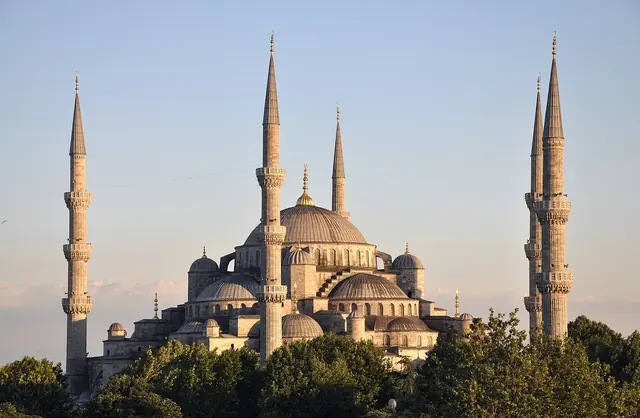
The adhan (ezan in Turkish) is the short, sung call that summons Muslims to prayer from the minarets five times a day. Its words are in Arabic, and in about fifteen phrases it proclaims God's greatness and oneness, affirms Muhammad as His messenger and invites people to pray. In Sultanahmet it is the sound that frames the day.
On this page8
The words of the adhan, line by line
The call as recited in Türkiye, following Hanafi practice. The number in brackets shows how many times each line is repeated:
- Allahu akbar (4): God is the Greatest.
- Ashhadu an la ilaha illallah (2): I bear witness that there is no god but God.
- Ashhadu anna Muhammadan rasulullah (2): I bear witness that Muhammad is the messenger of God.
- Hayya ala's-salah (2): Come to prayer!
- Hayya ala'l-falah (2): Come to success (salvation)!
- Allahu akbar (2): God is the Greatest.
- La ilaha illallah (1): There is no god but God.
The extra line at dawn
Only in the dawn call, after “hayya ala'l-falah”, the muezzin adds “as-salatu khayrun mina'n-nawm” twice: “Prayer is better than sleep.” It is the easiest way to recognise the dawn adhan by ear.
Muslims who hear the call quietly repeat each line; to the two “come to” lines they respond “la hawla wa la quwwata illa billah” (there is no power or strength except through God). A short prayer is said once the call ends.
The five prayer times
The times follow the sun, so they move by a minute or two each day and by hours between summer and winter. Turkish apps and calendars use the Turkish names:
- Sabah (Fajr): at first light, before sunrise. Calendars list the start of this window as imsak, which is also when the Ramadan fast begins.
- Öğle (Dhuhr): shortly after the sun passes its highest point.
- İkindi (Asr): in the afternoon, as shadows lengthen.
- Akşam (Maghrib): just after sunset; in Ramadan, the moment to break the fast.
- Yatsı (Isha): once the evening twilight has gone and it is fully dark.
Muezzins and musical modes
The person who calls the adhan is the muezzin. The first in Islamic history was Bilal, remembered for his beautiful voice. In Ottoman Istanbul the muezzins of great mosques were trained vocalists, and the call was sung within the modal system of Turkish classical music, the makam (maqam).
Tradition favours particular modes for particular times. One often-quoted scheme pairs dawn with saba, midday with uşşak, afternoon with hicaz, sunset with segâh and night with rast or hicaz. This is custom and taste rather than a rule, and it varies from muezzin to muezzin.
Why it sounds different every time
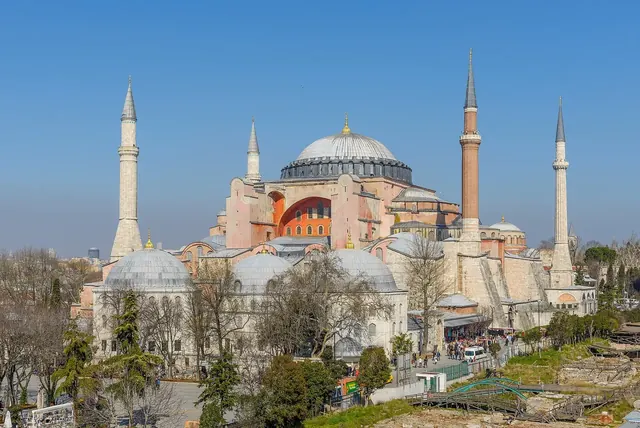
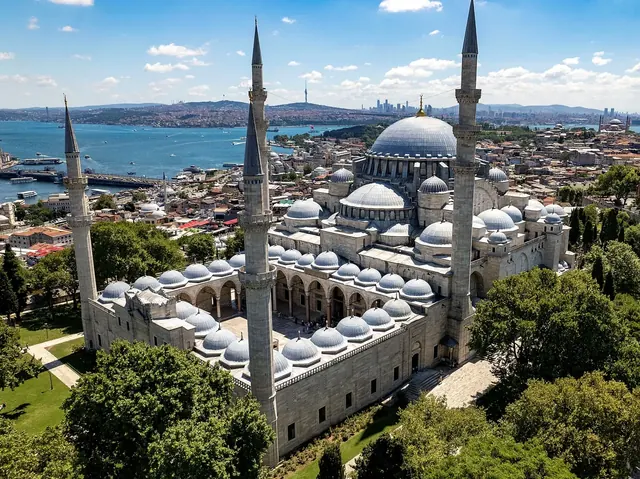
The old city has dozens of mosques a few hundred metres apart, each with its own muezzin. The calls start within seconds or minutes of one another and overlap, echo and sometimes seem to answer each other. On some special occasions the call is even sung alternately, line by line, between the Blue Mosque and Hagia Sophia.
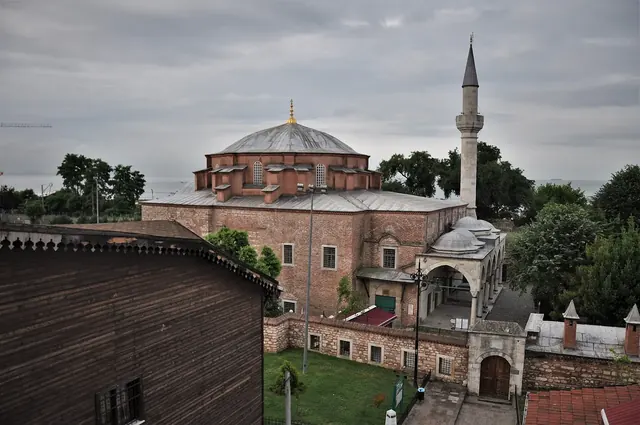
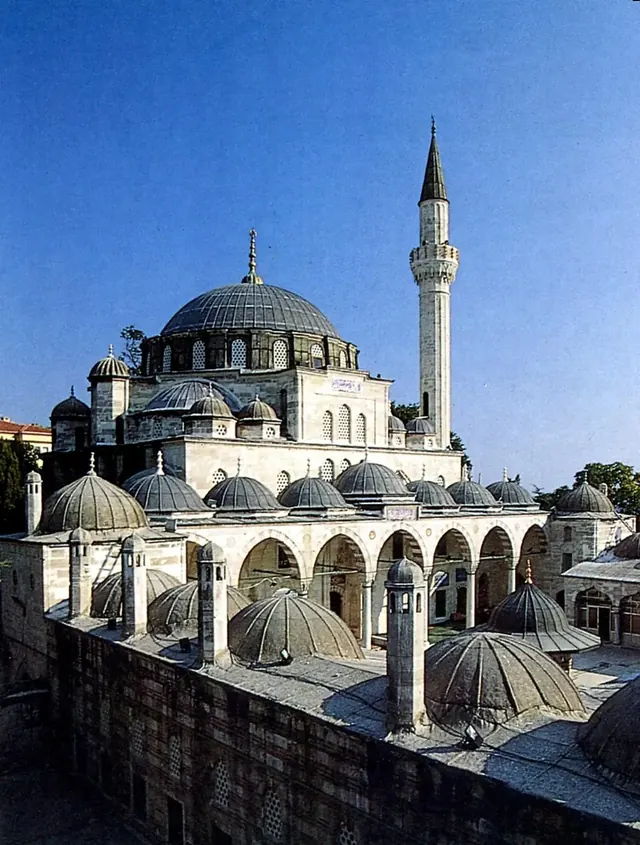
From the rooftop terrace of our hotel in Küçük Ayasofya you can hear Little Hagia Sophia, Sokullu Mehmet Pasha and more distant mosques layering over one another. Wind, voice and choice of mode make every call a little different.
What is the sela?
Sometimes you will hear a chant from the minaret that resembles the adhan but has different words: the sela, a sung blessing on the Prophet. On Fridays it is recited before the midday call to announce the approaching Friday prayer.
A sela heard outside the usual prayer times normally announces a death in the neighbourhood and an upcoming funeral prayer, so it is a moment of mourning for someone nearby.
1932–1950: when the adhan was sung in Turkish
During the language reforms of the early Republic, the call to prayer was switched to Turkish in 1932. For about eighteen years a Turkish text beginning “Tanrı uludur” (God is great) was the official adhan, and for part of that period reciting it in Arabic was legally banned.
In 1950 the Turkish parliament lifted the ban and the Arabic adhan returned. The episode is still discussed in Türkiye as part of the country's debates on religion and identity; we mention it here simply as history.
What should visitors do when they hear it?
Nothing in particular. Some people lower their voices, turn down music or pause for a moment, and you are welcome to do the same, but carrying on walking or eating is completely normal.
The practical point is that the adhan marks the start of a prayer time: mosques fill up and the big ones close to sightseeing for a while. Plan around it with our guide to Muslim prayer, and see our Friday prayer guide for Fridays. New to all this? Start with common questions about Islam.
Frequently asked questions
How many times a day is the call to prayer?
Five: dawn, midday, afternoon, sunset and night. On Fridays a sela is also sung before the midday call, and in Ramadan the dawn call marks the start of the day's fast.
Will the dawn call wake me up?
Mosques are very close together in the old city, so you are likely to hear it, and in summer it comes very early. It lasts only a few minutes, but light sleepers may like to know in advance.
Is it OK to record the call to prayer?
Recording it from the street or a terrace is fine and many visitors do. Inside a mosque, avoid filming people at prayer; see our mosque etiquette guide.
Is the adhan live or recorded?
In Türkiye it is generally sung live by each mosque's own muezzin and amplified through loudspeakers, which is why every mosque sounds a little different and you hear several voices at once.