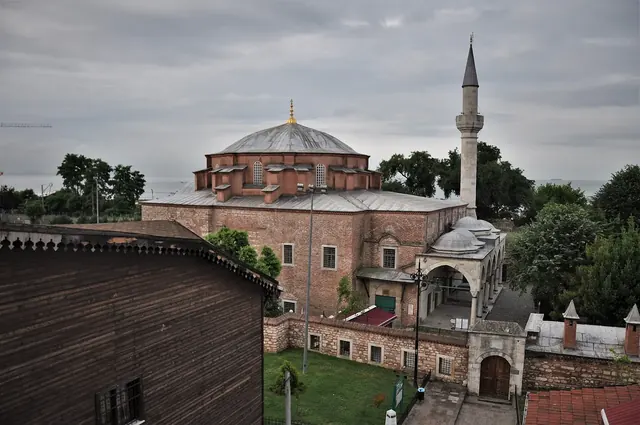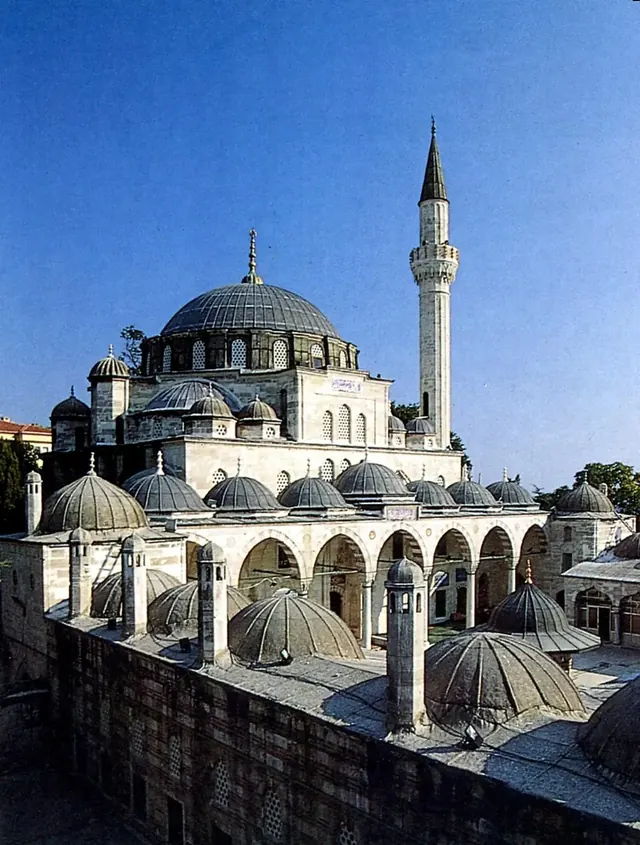
The Sokollu Mehmed Pasha Mosque is a small but flawless mosque complex built by Mimar Sinan in 1571–1572 for the grand vizier Sokollu Mehmed Pasha and his wife, Princess İsmihan Sultan. Its plain exterior hides some of the finest Iznik tilework of the golden age and fragments traditionally said to come from the Black Stone of the Kaaba. It sits on a hillside just south of the Hippodrome, and most visitors walk straight past it.
On this page6
A grand vizier, a sultan's daughter and Sinan
Sokollu Mehmed Pasha served as grand vizier for around fifteen years under Süleyman the Magnificent, Selim II and Murad III, making him one of the most powerful statesmen in Ottoman history. His marriage to İsmihan Sultan, daughter of Selim II, tied him to the dynasty itself. The couple commissioned the court architect Sinan, and the foundation inscription dates the building to 979 in the Islamic calendar — 1571–1572.
Sinan's genius here lies in turning a steep plot into drama. The madrasa wraps around a courtyard while the prayer hall sits on the upper terrace. Coming from the lower street, you climb a staircase that passes right beneath the madrasa's lecture hall and emerge, almost theatrically, into a courtyard with a fountain and the mosque's arcaded façade in front of you.
Iznik tiles at their absolute peak
Step inside and the tiled qibla wall takes over. The 1570s were the high point of the Iznik workshops: alongside turquoise and cobalt you will see the slightly raised coral red that only appears in this period. Tulips, carnations and flowing arabesques frame calligraphic panels above the windows. Even the pointed cap of the marble minbar is sheathed in tiles — a rare touch in Istanbul.
Look up at the wooden galleries and some of the arches for painted decoration preserved through careful restoration. The dome rests on a hexagonal arrangement, which makes this compact interior feel far larger and airier than its footprint suggests.
Where are the Kaaba stone fragments?
The mosque's most talked-about feature is a set of small black stone fragments traditionally said to have been brought from the Black Stone (Hajar al-Aswad) at the corner of the Kaaba in Mecca. According to accounts, they were set above the entrance door, in the mihrab and on the minbar, and they are displayed in small frames. Please look respectfully rather than touching. For many Muslim travellers this makes the mosque a meaningful spiritual stop; our guide for Muslim travellers has more ideas.
Don't miss these
- The tiled minbar cap: the turquoise cone topping the marble minbar is the mosque's signature detail.
- The mihrab wall: tile panels and calligraphy make this the best spot for a photo (no flash).
- The madrasa courtyard: arcades and a central fountain show Sinan's sense of proportion on an intimate scale.
- The staircase under the lecture hall: enter from the lower street and climb up to experience the building in the sequence Sinan intended.
Practical visiting notes
Entry is free. This is a neighbourhood mosque, so it may be locked between prayers; arriving shortly before a prayer time — and waiting until it ends before looking around — is the most reliable approach. Dress rules are the same as at any mosque. If Sinan's work catches your imagination, follow our Mimar Sinan route across the city.
Getting there from Sareban Hotel
This is the closest Sinan mosque to our hotel, a short uphill walk of a few minutes. Keep climbing afterwards and you soon reach the Hippodrome and the Blue Mosque; come back down via Little Hagia Sophia for a neat little loop.
Frequently asked questions
Does the Sokollu Mosque really have pieces of the Kaaba stone?
By long-standing tradition, small fragments of the Black Stone were set above the door, in the mihrab and on the minbar. It is a tradition rather than a documented fact, but the fragments can be seen in their frames.
Is the mosque always open?
No. As a neighbourhood mosque it may be closed between prayers, so visiting close to prayer times is the safest bet.
Who built it?
Mimar Sinan, the great Ottoman architect, built it for grand vizier Sokollu Mehmed Pasha and his wife İsmihan Sultan in 1571–1572.
Is it far from Sultanahmet Square?
Not at all. It sits on the slope just south of the Hippodrome, a few minutes' walk from the square.