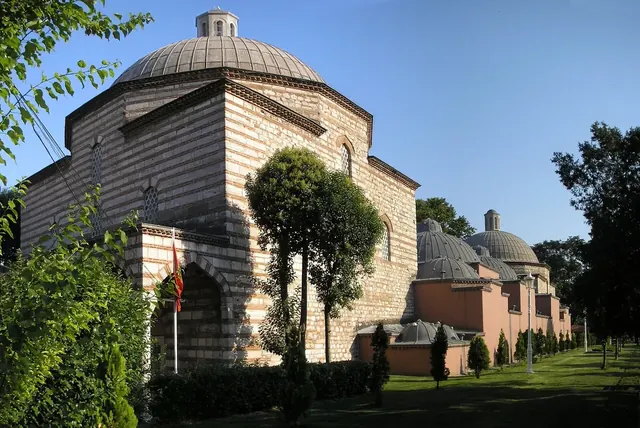
The Haseki Hürrem Sultan Hamam is a double bathhouse built by Mimar Sinan in 1556–1557 for Hürrem Sultan, wife of Süleyman the Magnificent, on the square between Hagia Sophia and the Blue Mosque. Its women's and men's sections are laid out end to end along a single axis, a plan that makes it unique among Sinan's bathhouses. After many decades serving other purposes, it was restored and reopened as a working hamam.
On this page5
A bathhouse for Hagia Sophia's congregation
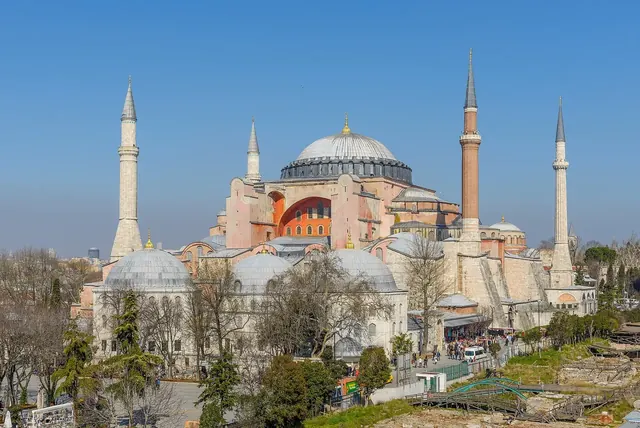
Once Hagia Sophia became a mosque after the Ottoman conquest, the neighbourhood and its worshippers needed new buildings for daily life. Hürrem Sultan — known in Europe as Roxelana — left many charitable foundations across the city as Süleyman's favourite and later his wife. This hamam was part of her endowment, built both to serve the congregation of Hagia Sophia and to generate income for her foundation.
The site itself is steeped in history. According to historical sources, it lies close to where the great Baths of Zeuxippus, famous for their statues, stood in Byzantine times — so this corner of the city has been associated with bathing for well over a thousand years, across empires.
Sinan's game of symmetry: a double hamam on one axis
In most Ottoman double hamams the women's and men's sections sit side by side. Here Sinan did something different: he placed the two sections end to end on the same axis, creating a long, symmetrical building that runs parallel to the square between Hagia Sophia and the Blue Mosque. The entrances are at opposite ends, so women and men could come and go without ever crossing paths.
Each section has a large domed changing hall, a warm room and a hot room. The hot rooms follow the plan Sinan often used, with vaulted alcoves and corner private cubicles around a central marble platform, beneath domes pierced with small skylights. From outside, the row of domes gives away the layout within.
From carpet hall back to hamam
After centuries of use, the hamam closed in the early 20th century. In the decades that followed it served as a storehouse and, for a long time, as a showroom for hand-woven carpets — which is how many earlier visitors remember it. A thorough restoration that began in the late 2000s saw it reopen as a hamam in 2011, with its marble surfaces, domes and heating system renewed, returning the building to its original purpose.
What you can see even from outside
- The dome skyline: from Sultanahmet Park, the hamam's row of domes lines up with Hagia Sophia's great dome behind it.
- The colonnaded porch: the portico in front of the men's section shows Sinan's restrained but elegant approach to façades.
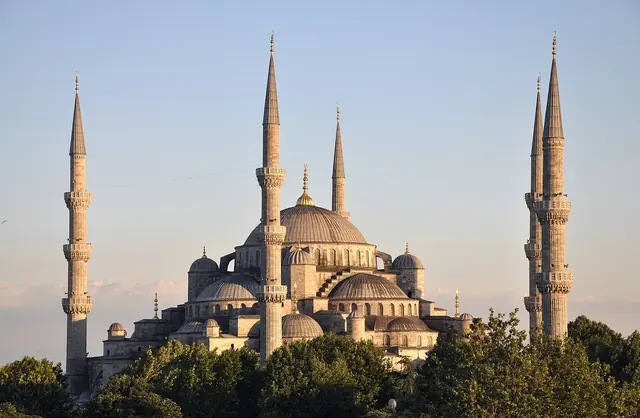
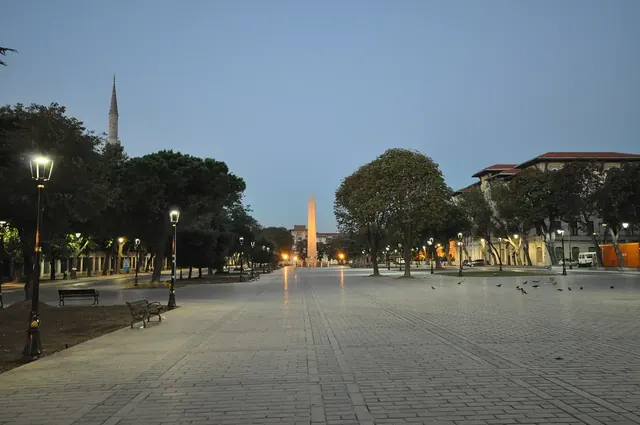
- Between two giants: the hamam sits right between Hagia Sophia and the Blue Mosque, in the middle of the Old City's busiest square.
- The Arasta side: the lane behind the hamam leads down to the Arasta Bazaar and the Mosaic Museum.
Getting there from Sareban Hotel
The hamam is on Sultanahmet Square, an uphill walk from our hotel: pass the Sokollu Mehmed Pasha Mosque, climb to the Hippodrome and walk past the Blue Mosque into the park; the hamam stands at the edge of the park facing Hagia Sophia. It takes 10–15 minutes depending on your pace. For etiquette and first-timer advice, read our guide to Turkish bath culture.
Frequently asked questions
Is the Hürrem Sultan Hamam still a working bathhouse?
Yes. It reopened as a hamam in 2011 after restoration and has separate sections for women and men. Check current conditions directly with the hamam.
Who built it?
Mimar Sinan built it in 1556–1557 for Hürrem Sultan, wife of Süleyman the Magnificent.
Can I see it without going in?
Yes. It stands at the edge of Sultanahmet Park, and its domes and portico are easy to see from the square between Hagia Sophia and the Blue Mosque.
What makes this hamam different?
Its women's and men's sections are placed end to end on one axis instead of side by side — a rare solution among Ottoman double hamams.