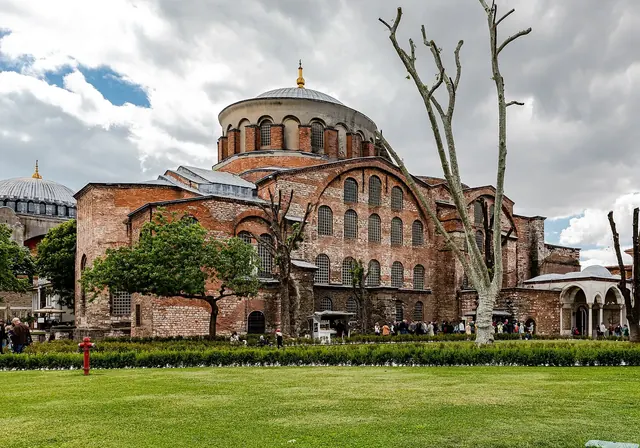
Hagia Irene, the Church of Holy Peace, is one of the oldest churches in Istanbul, a Byzantine building that took its present form in the 6th and 8th centuries. It stands in the first courtyard of Topkapı Palace, just northeast of Hagia Sophia. Because it was never converted into a mosque, it offers a rare look at an unadorned Byzantine interior; it is visited as a separate museum with its own ticket.
On this page4
The great church before Hagia Sophia
The first church here was built in the 4th century and served as one of the city's principal churches until Hagia Sophia was completed. In 381 it hosted the Second Ecumenical Council (First Council of Constantinople), which gave one of Christianity's core creeds its final form. The church burned with Hagia Sophia in the Nika riots of 532 and was rebuilt by Justinian.
After heavy damage in the earthquake of 740, it was repaired under Emperor Constantine V, during the Iconoclast period when religious images of people were banned. That is why the apse half-dome shows not a saint but a large black cross on a gold ground, one of the few surviving original decorations from that era.
Arsenal, first museum and concert hall
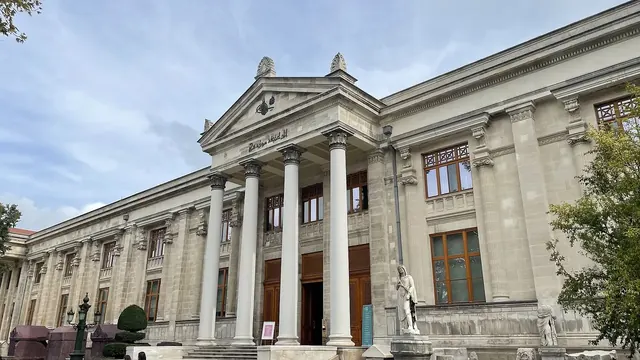
After the conquest, Hagia Irene fell within the outer walls of Topkapı Palace and, instead of becoming a mosque, served as the Janissaries' armoury. In 1846 the Ottoman field marshal Ahmed Fethi Pasha gathered old weapons and antiquities here, a collection regarded as the beginning of museums in the Ottoman Empire; the antiquities later formed the nucleus of the Istanbul Archaeology Museums.
Through much of the 20th century it was a military museum. Its remarkable acoustics made it a venue for international music festival concerts from the 1980s, and after a thorough restoration it reopened as a museum in 2014.
What to look for
- The apse cross: The gold-ground mosaic cross from the Iconoclast period.
- The synthronon: Tiered stone benches for the clergy curving around the apse, said to be the only original example surviving in Istanbul.
- Dome meets basilica: A transitional design combining a long basilica with a dome, perfect for comparing with Hagia Sophia.
- The atrium: The arcaded forecourt on the west side, a rare surviving Byzantine church courtyard.
- Bare walls: Exposed brick and stone let you read Byzantine building techniques directly.
Getting there from Sareban Hotel
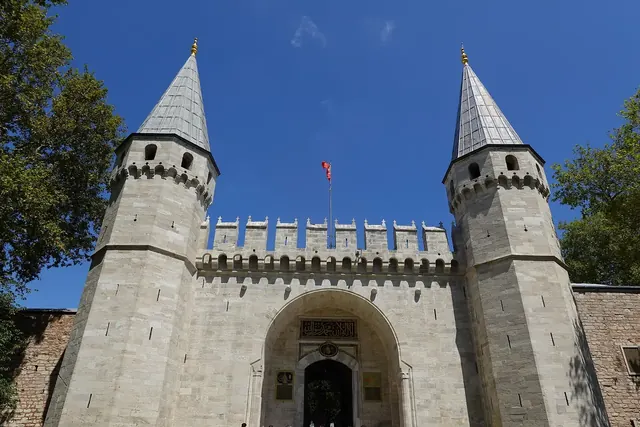
Walk from our hotel across the Hippodrome, pass behind Hagia Sophia and enter Topkapı's first courtyard through the Imperial Gate at the top of Soğukçeşme Street; Hagia Irene rises immediately on your left. The first courtyard is free, so you can admire the exterior without a palace ticket, but going inside requires a separate ticket.
Frequently asked questions
Is Hagia Irene included in the Topkapı Palace ticket?
Hagia Irene operates as a separate museum and usually needs its own ticket, though some combined tickets may include it. Check the official website for current options.
Why was Hagia Irene never turned into a mosque?
It lay inside the palace walls and was used as the Janissaries' armoury, later becoming a museum and concert venue.
Are concerts still held in Hagia Irene?
Thanks to its acoustics it has hosted festival concerts for decades. Programmes vary by year, so check announcements before your visit.