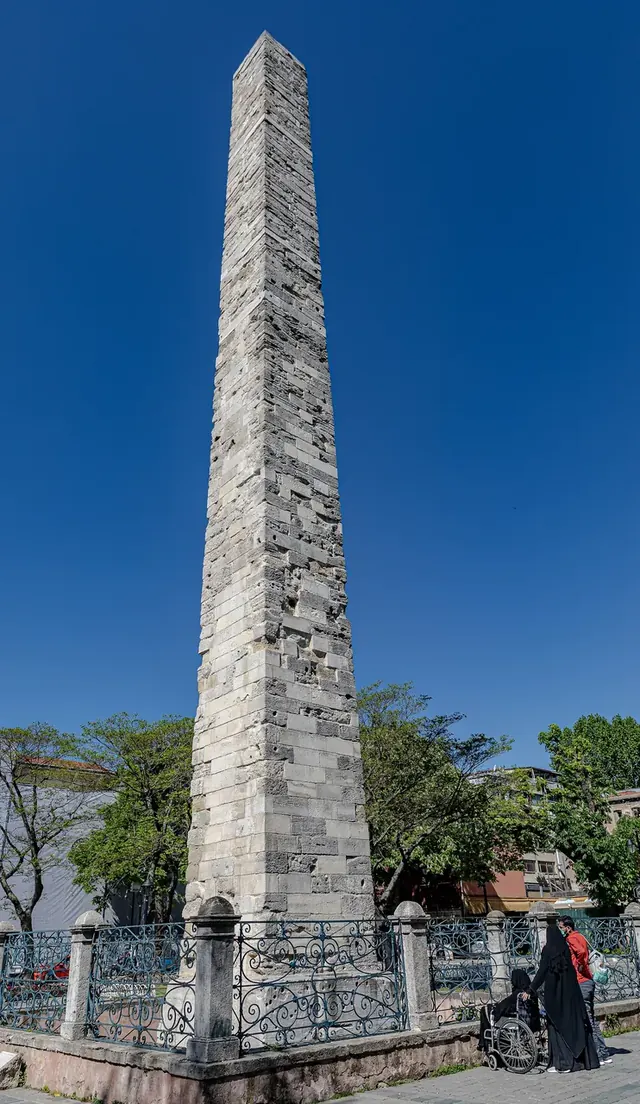
The Walled Obelisk is a roughly 32-metre obelisk built of rough-cut stone blocks at the southern end of Sultanahmet Square, the old Hippodrome. Its original date is uncertain, but in the 10th century Emperor Constantine VII restored it and had it sheathed in gilded bronze. The bare, pockmarked surface you see today is one of the clearest scars left by the Crusader sack of 1204.
On this page4
A home-made rival to Egypt
The central barrier of the Hippodrome already had a genuine Egyptian monolith, the Obelisk of Theodosius, and the southern end needed a counterpart. Instead of a single granite shaft, this one was assembled from irregular stone blocks. No source gives its exact date; many historians place it in the 4th century.
A Greek inscription on the base says the monument had decayed with time and was renewed by Emperor Constantine VII Porphyrogennetos. It compares the obelisk to the Colossus of Rhodes, one of the Seven Wonders, and boasts that the restored version is even more marvellous. That is why it is also known as the Obelisk of Constantine.
Where the bronze went
After the restoration, all four faces glittered with gilded bronze plates. When the Fourth Crusade sacked the city in 1204, soldiers stripped the plates and melted them down for coins and weapons. The rows of holes you see today are where the metal clamps once held the sheathing; look closely and you will notice how regularly they are spaced.
According to popular tradition, young Ottoman palace cadets later climbed the stones to show off their agility and courage. The obelisk has needed repairs several times over the centuries as its masonry weathered.
What to look for
- Clamp holes: Neat rows marking where the bronze plates were fixed.
- The base inscription: The poetic Greek text that name-drops the Colossus of Rhodes.
- The sunken base: A reminder that the racetrack lay well below today's square.
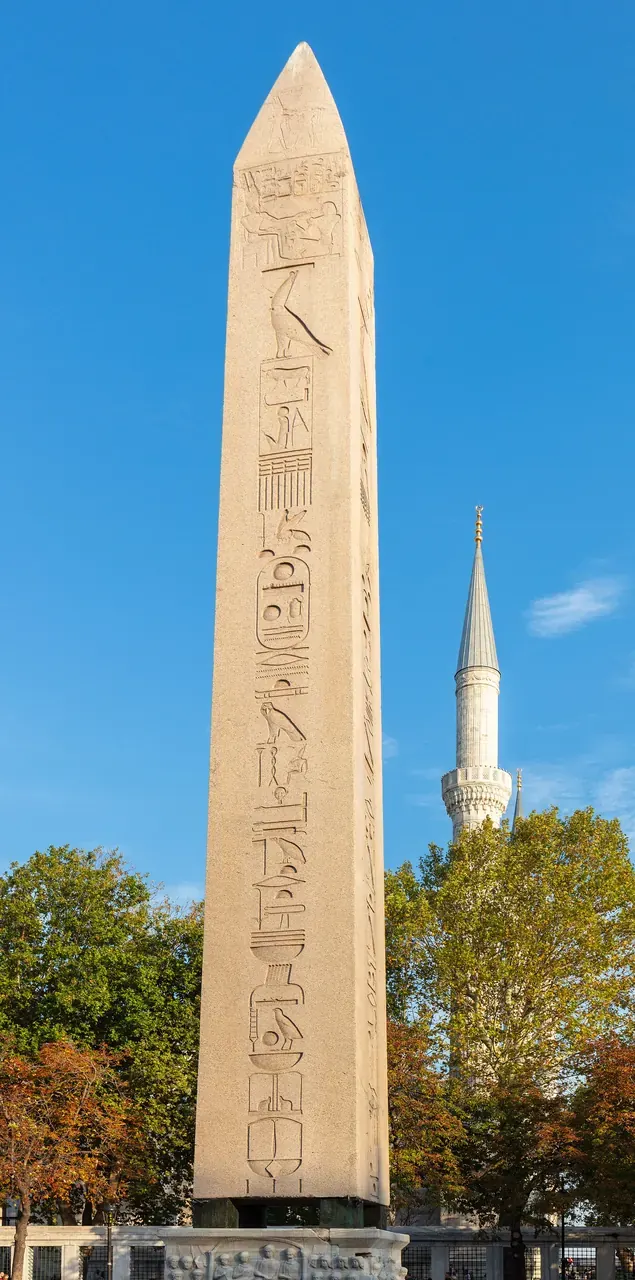
- Two obelisks, two methods: Compare this stacked-stone tower with the single granite shaft further north.
Getting there from Sareban Hotel
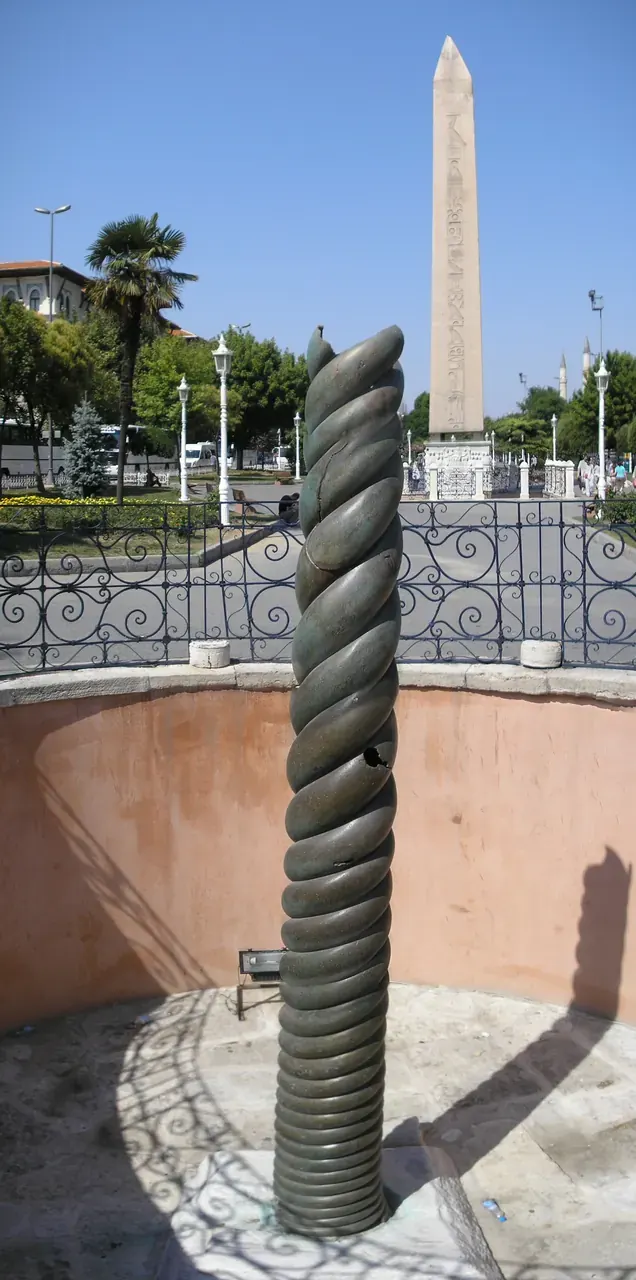
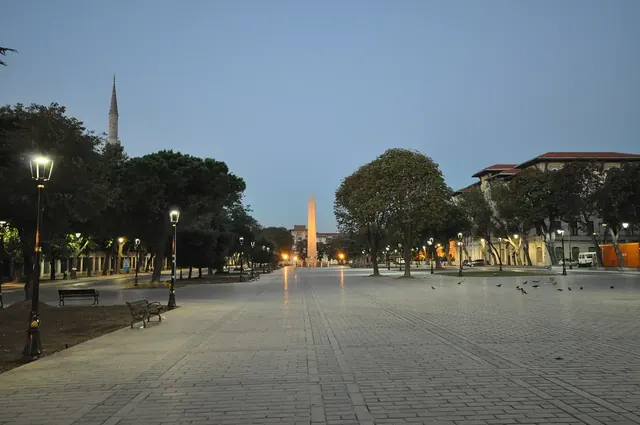
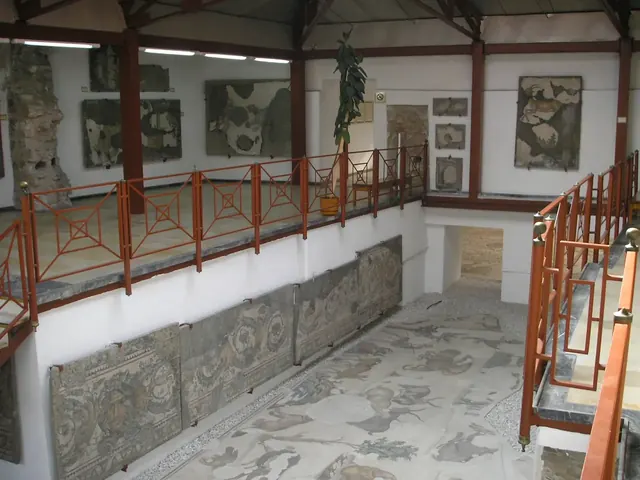
This is the first monument you meet when you walk up from our hotel: climb the slope from Küçük Ayasofya and it rises straight ahead at the southern end of the square. From here, walk north past the Serpent Column and the Obelisk of Theodosius to the German Fountain to see every monument on the Hippodrome. The nearby Great Palace Mosaic Museum rounds off the Byzantine story with floor mosaics from the emperors' palace.
Frequently asked questions
When was the Walled Obelisk built?
Its exact date is unknown; most sources suggest the 4th century. The inscription on the base records a restoration by Constantine VII in the 10th century.
What are the holes in the stone?
They held the clamps for gilded bronze plates that once covered the obelisk. Crusaders stripped and melted the plates in 1204.
How is it different from the Obelisk of Theodosius?
The Obelisk of Theodosius is a single piece of Egyptian granite brought from Karnak, while the Walled Obelisk was built in Constantinople from stacked stone blocks.