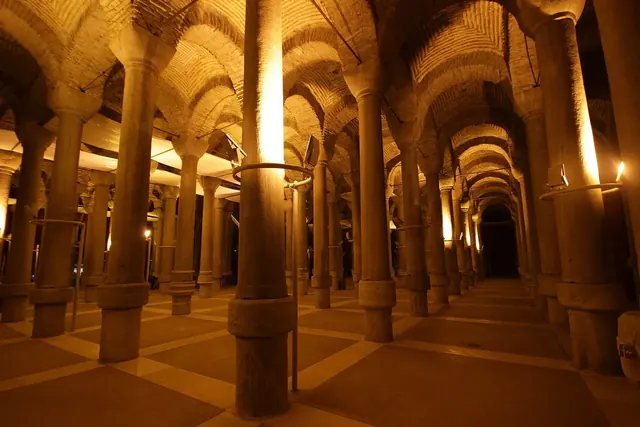
Binbirdirek Cistern, west of the Hippodrome in Sultanahmet, is generally considered Istanbul's second-largest covered Byzantine cistern after the Basilica Cistern. Tradition credits its first construction to the senator Philoxenos in the 4th century, with major rebuilding in later centuries. Long since drained, it is a dry hall where a forest of tall, two-tiered columns creates a very different mood from its famous water-filled neighbour.
On this page6
A reservoir named after a senator
According to tradition, the cistern was commissioned by Philoxenos, a senator who followed Constantine from Rome to the new capital; Byzantine sources accordingly call it the Cistern of Philoxenos. The structure you see today is thought to date largely from rebuilding or enlargement in the 5th and 6th centuries. It stored water for the palaces, baths and mansions that crowded this part of the city.
Under the Ottomans the cistern no longer held water. The dry hall is known to have been used for a long time as a workshop by silk-thread spinners, who valued its cool, humid air. Later it partly filled with rubble and earth, and it was only cleared, restored and reopened to visitors in the 2000s.
Not quite 1001 columns
Binbirdirek means “one thousand and one columns”, a folk exaggeration. Sources describe a hall planned with over two hundred columns in regular rows, most often given as 224. What makes them remarkable is that each is built from two shafts stacked one on top of the other and joined by a stone collar. Because part of the floor silted up over the centuries, the columns look shorter today than they originally were.
Look closely at the shafts and you may spot Greek letters and monograms carved by the stonemasons, usually interpreted as marks identifying the workshop that produced each piece. Above, rows of small brick domes show how Byzantine engineers roofed a huge space with remarkably light materials.
What to look for
- Stacked columns: the stone collars joining upper and lower shafts give the hall its distinctive rhythm.
- Masons' marks: hunt for letters and monograms on the shafts; lighting makes some easy to find.
- Brick vaults: the neat grid of shallow domes that forms the ceiling.
- The view from the stairs: pause as you descend; it is the best moment to take in the full scale of the hall.
Check before you go
Since its restoration, Binbirdirek has doubled as a venue for exhibitions, concerts and private events. On event days visiting may be restricted, the layout may change, or the cistern may be open only to invited guests. Opening arrangements, tickets and hours have varied over the years, so confirm the current situation with official sources or ask at our reception before setting out.
Being dry, it has no water or fish as at the Basilica Cistern; instead you can see the columns from floor to vault and read the structure much more clearly. Our guide to Istanbul's cisterns compares the options and covers other underground sites.
Nearby and a cistern walk
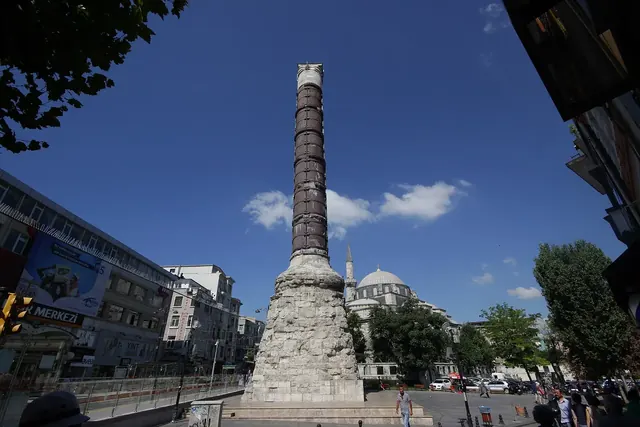
Binbirdirek sits in the middle of an easy three-cistern walk: the Basilica Cistern is a few minutes east, and the smaller, dramatically lit Theodosius Cistern a few streets west. Afterwards, walk up to Divanyolu to see the Firuz Ağa Mosque and the Column of Constantine. Cool and sheltered, it is also a good addition to your rainy-day plans.
Getting there from Sareban Hotel
From our hotel in Küçük Ayasofya, walk uphill towards the west side of the Hippodrome, then from the north-west corner of the Hippodrome continue a few minutes into the streets behind the old courthouse building, where a small entrance pavilion leads down to the cistern. By tram, get off the T1 at Sultanahmet or Çemberlitaş and walk a short distance.
Frequently asked questions
How is Binbirdirek different from the Basilica Cistern?
The Basilica Cistern is larger, still holds water and is one of the busiest sights in town. Binbirdirek is dry, quieter and shows off its tall, two-tiered columns from floor to ceiling.
Is Binbirdirek Cistern open every day?
Because it also hosts events, opening days and hours can change. Check the current situation shortly before your visit.
Does it really have 1001 columns?
No, the name is poetic exaggeration. Sources describe more than two hundred columns, most often given as 224.