Cankurtaran and Ahırkapı make up a small seaside quarter on the slope directly below the Blue Mosque and the outer walls of Topkapı Palace. Guesthouses in restored timber houses, sea-view rooftop terraces and the still-working Ahırkapı lighthouse define it. It is minutes from the great monuments yet noticeably calmer once evening falls.
On this page7
A narrow strip between the palace wall and the sea wall
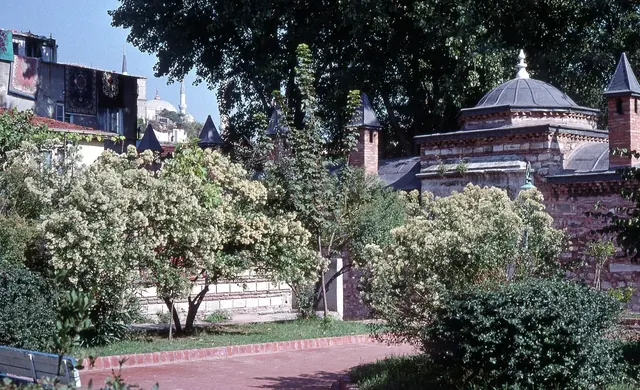
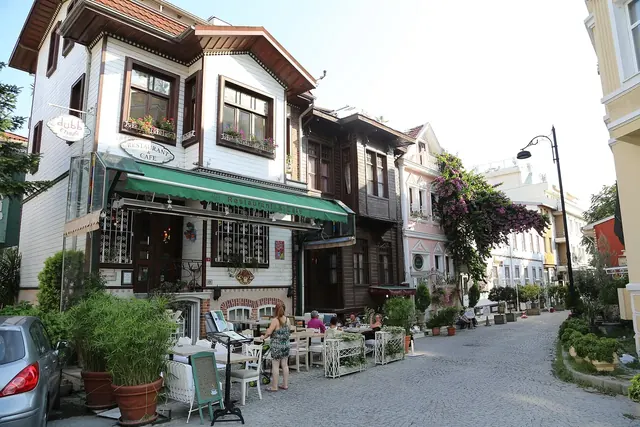
The neighbourhood is squeezed onto a thin slope between the outer walls of Topkapı Palace and the Byzantine sea walls. Look one way down almost any street and you see the Blue Mosque's minarets; look the other and you see water. From the bottom of the Arasta Bazaar the lanes tumble towards the shore past small guesthouses, carpet and ceramic shops, potted geraniums and vines trailing from balconies.
Cankurtaran has its own daily rhythm: travellers breakfasting on rooftops in the morning, local children coming home from school in the afternoon, anglers casting from the foot of the walls at dusk. Nearly every roof doubles as a viewing deck, taking in the ships anchored off the mouth of the Bosphorus, the Princes' Islands and, on clear days, the Asian shore.
A sea gate named after the palace stables
Ahırkapı means Stable Gate: the imperial stables of the Ottoman palace stood nearby, and this opening in the sea walls served the palace horses and grooms. The origin of the name Cankurtaran, roughly ‘lifesaver’, is less clear; several local stories are told, and none is firmly documented.
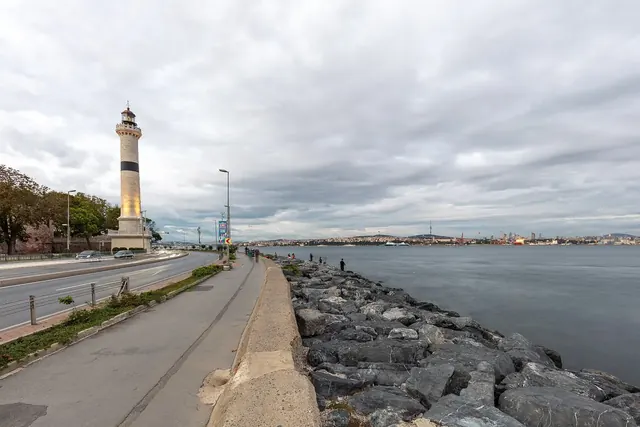
In Byzantine times this shore bordered the sea gardens and landing stages of the Great Palace, and brick vaults from that era can still be spotted in house foundations and on the inner face of the walls. The Ahırkapı lighthouse, established in the mid-18th century, still guides ships approaching the Bosphorus from the Marmara. When the coast road was built in the late 1950s, land was reclaimed in front of the walls, leaving a road and a broad green strip between the houses and the sea.
What to see in and around the quarter
- Ahırkapı Lighthouse: a white tower set into the line of the walls. As a working navigation light it is usually closed inside; the best view is from the seafront path.
- Marmara Sea Walls: the Byzantine shoreline defences, traceable in stretches towards Seraglio Point and westwards, studded with reused marble blocks and weathered inscriptions.
- İshak Paşa Street: a quiet road running along the outer walls of Topkapı Palace, named after a small 15th-century mosque on its route.
- At the top of the neighbourhood sit the Great Palace Mosaic Museum and the Arasta Bazaar, an easy starting point for exploring Cankurtaran.
Walk: from the Arasta to the lighthouse and along the walls
- Enter Cankurtaran from the lower end of the Arasta Bazaar and wind down through the guesthouse lanes towards the sea.
- Follow İshak Paşa Street beside the palace walls and watch for places where courses of stone and brick change, a sign of repairs from different centuries.
- Pass through the opening in the walls at Ahırkapı, or the underpass beneath the railway, to reach the shore and the lighthouse.
- Turn west along the seafront beneath the sea walls as far as the Bukoleon Palace ruins, then climb back up through Küçük Ayasofya and Kadırga to complete the loop.
Rooftop breakfasts and gözleme from the griddle
Food in Cankurtaran revolves around breakfast. A full Turkish spread of cheeses, olives, honey with clotted cream, tomatoes and cucumbers, jams and a pan of menemen (eggs scrambled with tomato and peppers) or eggs with spicy sucuk sausage becomes something special when it is served on a rooftop overlooking the sea. Warm pişi, a puffy fried dough, and fresh simit complete the table.
Later in the day, gözleme (thin flatbread folded around spinach, cheese or potato and cooked on a griddle), lentil soup and manti dumplings with garlicky yoghurt make easy lunches. For something sweet, milk puddings such as sütlaç and kazandibi are a light finish. Our Istanbul food guide gives the bigger picture.
Families: open space by the sea, care by the walls
The seafront walking and cycling path, with its lawns and benches, is a relaxed open space for children. Watching the anglers, the gulls and the ships at anchor keeps younger kids happy for longer than you might expect.
Some sections of the walls are unrestored, so don't let children climb them, and keep clear of places where stones look loose. The inner lanes are steep and sometimes stepped; if you have a pushchair, the seafront is the easier route.
Getting there from Sareban Hotel
There are two pleasant ways to walk from our hotel. The inland route heads east past Little Hagia Sophia towards the lower side of the Mosaic Museum, short and gently undulating. The seaside route drops downhill to Kennedy Avenue and follows the promenade east; after the Bukoleon ruins the Ahırkapı lighthouse comes into view.
Either way usually takes around 10–15 minutes. Go out one way and come back the other and you have a neat little loop.
Frequently asked questions
Can you go inside the Ahırkapı lighthouse?
It is still a working navigation light, so it is generally not open to visitors. The best views are from the seafront path and the lawn in front of the walls.
Is it a hard walk from Cankurtaran up to Sultanahmet Square?
The upper lanes are only a few minutes from the Arasta Bazaar and the rear courtyard of the Blue Mosque. From the lowest streets it is a short but steep climb.
Will I find sea views in the neighbourhood?
Yes. Many buildings on the lower slope have roofs looking over the Marmara and the ships. We've collected the city's best evening viewpoints in our sunset spots guide.