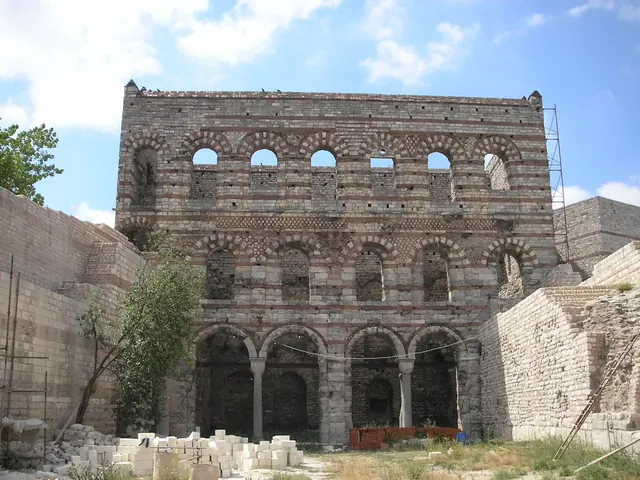
Tekfur Palace, also known as the Palace of the Porphyrogenitus, is the best-preserved Byzantine palace building left in Istanbul, a surviving wing of the late imperial residence at Blachernae. Wedged between two lines of the land walls near Edirnekapı, its three-storey patterned facade now fronts a museum telling the story of the Ottoman tile and glass workshops that once operated inside.
On this page5
When the emperors moved house
For centuries Byzantine emperors lived in the Great Palace, which spread from today's Sultanahmet down to the Marmara shore, just around the corner from our hotel; fragments survive at the Great Palace Mosaic Museum and the Boukoleon Palace ruins. From the Komnenian era onwards, court life gradually shifted to Blachernae, at the city's north-western tip above the Golden Horn.
Tekfur Palace is the one substantial building of that complex still standing, generally dated to the late 13th or early 14th century under the Palaiologan dynasty. Western sources call it the Palace of the Porphyrogenitus, meaning born in the purple, though which prince the name refers to is debated. Tekfur was the title the Ottomans used for the Byzantine ruler and local Christian lords.
Reading a Palaiologan facade
The palace rises three storeys: an arcade at ground level opening onto a courtyard, and two floors of wide windows above. The walls are dressed in red brick and white marble laid in chequerboards, lozenges and rosettes, the hallmark ornament of late Byzantine building. Nowhere else in Istanbul can you see this colourful geometry preserved on such a scale, so step back into the courtyard to take in the whole composition.
Tiles and glass under the Ottomans
After 1453 the building served several purposes; travellers even describe exotic animals being kept here for a time. Its most interesting chapter came in the early 18th century, during the Tulip Era, when Grand Vizier Nevşehirli Damat İbrahim Pasha backed a tile workshop here to revive the declining Iznik tradition in the capital. Tekfur Palace tiles can still be seen in buildings such as the Hekimoğlu Ali Pasha Mosque of the 1730s. After tile production ended, a glass workshop operated on the site for a while.
Excavations uncovered kilns and production waste, and these finds form the heart of the museum's displays.
Inside the museum
- Tile and glass finds: fragments, kiln furniture and vessels, with clear panels explaining how the workshops ran.
- The Byzantine facade: best appreciated from the far side of the courtyard.
- Upper floors and terraces: wide views over the Golden Horn, Ayvansaray and the double line of the land walls.
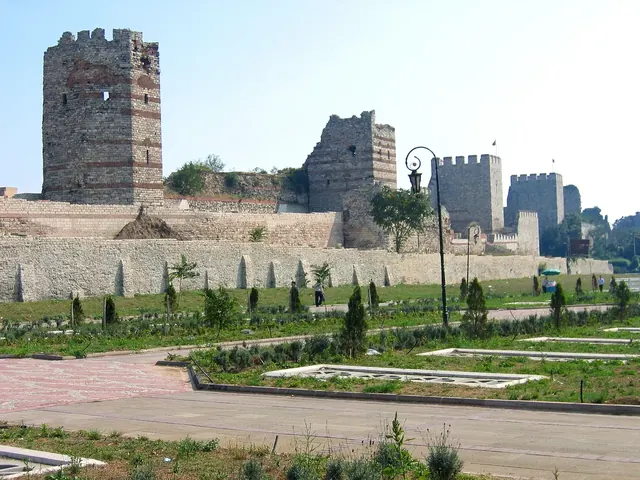
- The walls next door: see where the fortifications bend down towards the Golden Horn around Blachernae.
Getting there from Sareban Hotel
A taxi from the hotel is the most comfortable option. By public transport, head to Eminönü and take the Golden Horn ferry to Balat or Ayvansaray, then walk uphill to the palace. Alternatively, ride the T1 tram to Aksaray or Topkapı, change towards Edirnekapı and walk via the Chora Church.
The museum is a natural stop on a walk north along the Theodosian Walls or around Edirnekapı and Kariye, and its indoor galleries make it a good choice on a rainy day.
Frequently asked questions
Why is it called Tekfur Palace?
Tekfur was the Ottoman title for Byzantine rulers and local lords. The building belonged to the late Byzantine palace quarter of Blachernae.
Is there an entrance fee?
Yes, it is a ticketed museum. Check official sources for current prices and opening hours.
Is it worth visiting with children?
Older children usually enjoy the terraces and the idea of a real Byzantine palace; the displays are compact, so the visit is not tiring.