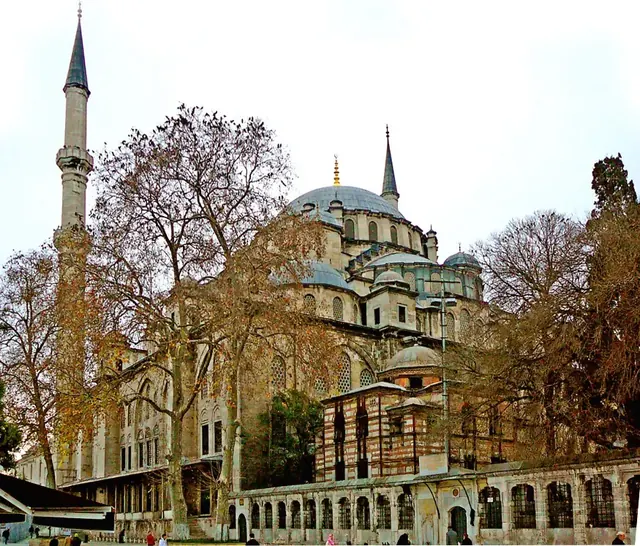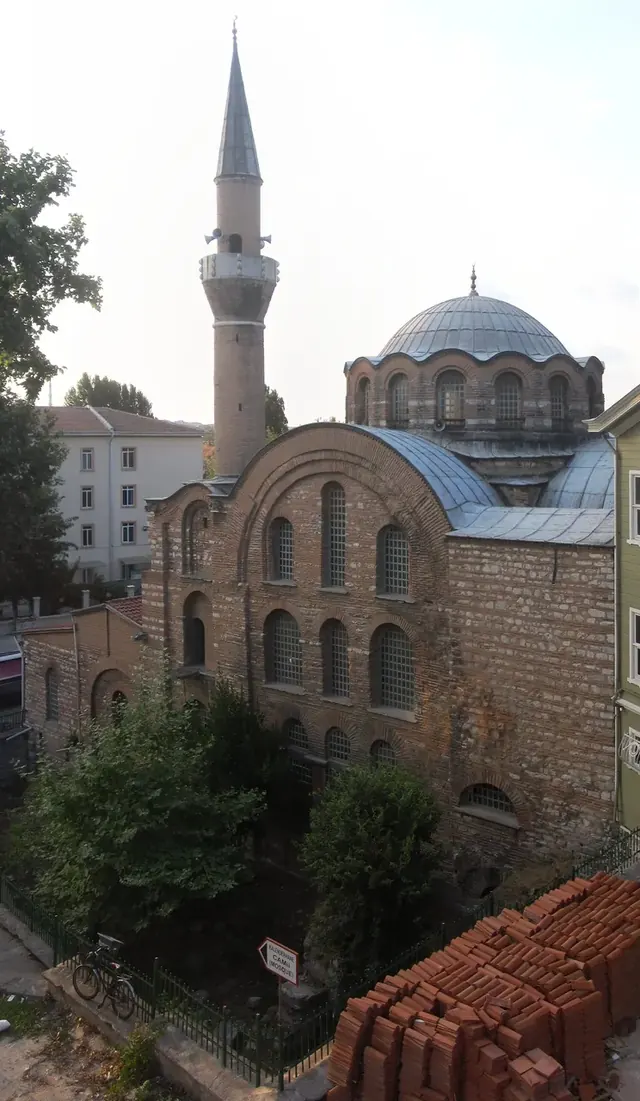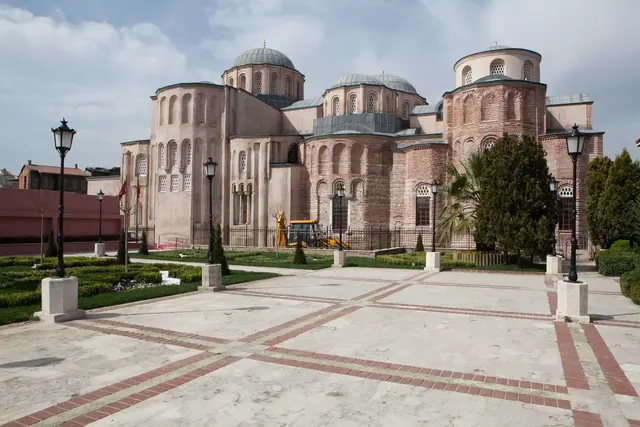
Zeyrek Mosque is the former Pantokrator Monastery, a trio of linked 12th-century churches founded by the Komnenos dynasty and, after Hagia Sophia, the largest surviving middle-Byzantine religious building in Istanbul. It crowns a slope above the Golden Horn in Zeyrek, a UNESCO-listed quarter of wooden houses, and it is one of the most rewarding lesser-known stops in the old city.
On this page5
A monastery founded by an empress
Emperor John II Komnenos and his wife Empress Eirene, born Piroska, a Hungarian princess, founded the monastery between roughly 1118 and 1136. The large south church, dedicated to Christ Pantokrator, came first; a north church dedicated to the Virgin Eleousa followed, and between them the couple inserted a chapel of the Archangel Michael to serve as the dynasty's mausoleum. From outside the three read as one long building with five domes and three apses.
The monastery's founding charter of 1136 describes a fifty-bed hospital with specialist wards, an old people's home and paid doctors, making it a key document in the history of medieval medicine. John II, Eirene and Manuel I were buried here, and later several Palaiologan emperors were laid to rest in the same chapel.
From Molla Zeyrek’s college to a neighbourhood mosque
During the Latin occupation of 1204–1261 the monastery was in Venetian hands. After 1453 Mehmed II turned it into a madrasa; its first teacher, according to tradition, was the scholar Molla Zeyrek, who gave both the mosque and the neighbourhood their name. Until the colleges of the Fatih Mosque were finished, this was one of the city's main centres of higher learning.
The south church later became a mosque and suffered centuries of earthquakes, fires and neglect. It reopened for worship after a long, extensive restoration. Among the finds was a large part of the church's original floor of coloured marble inlay (opus sectile), which is today mostly protected beneath the prayer carpets.
What to look for
- The apses: walk around to the Golden Horn side to see three polygonal apses and banded brick-and-stone masonry, a textbook example of Komnenian building.
- The domes: the windowed drum of the south church and the ghost of the marble columns that once carried it.
- Marble door and window frames: finely carved Byzantine surrounds sitting beside later Ottoman repairs.
- The view: from the terraces around the mosque, a sweep over the Golden Horn towards Süleymaniye and Galata.
Zeyrek: a UNESCO quarter people still live in
The streets around the mosque form one of the four zones of the Historic Areas of Istanbul World Heritage Site. Steep lanes are lined with timber houses with projecting bay windows, small fountains and neighbourhood prayer rooms; some houses are lovingly restored, others fragile. Please remember these are homes, so photograph facades rather than people's windows and doorways.
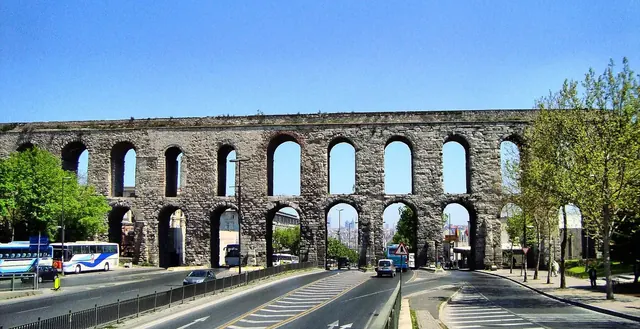
The Valens Aqueduct is at the bottom of the hill. For a full Byzantine day, combine Zeyrek with the Chora and Pammakaristos churches, following our Byzantine Istanbul route.
Getting there from Sareban Hotel
From the hotel, take the T1 tram to Beyazıt or Laleli, walk towards the aqueduct, cross the wide Atatürk Boulevard and climb the lanes up to Zeyrek. Alternatively, go down to Eminönü and catch a bus or taxi towards Unkapanı and the Atatürk Bridge, then tackle the short, steep climb from there.
The streets are cobbled and steep in places, so if you have a pushchair or limited mobility, a taxi to the door of the mosque is the comfortable option.
Frequently asked questions
Was Zeyrek Mosque originally a church?
Yes. It was built in the 12th century as the churches of the Pantokrator Monastery, then served as a madrasa after 1453 and later as a mosque.
Are there mosaics inside?
No figural mosaics survive. The attraction is the architecture itself: the domes, marble details and exterior masonry. The restored marble floor is mostly under carpets.
Do I need a ticket?
No. As a functioning mosque it is free to enter, though tourist visits are not appropriate during prayers.