Yedikule Fortress, the Castle of the Seven Towers, wraps around the Golden Gate, the ceremonial entrance of Byzantine emperors, and was turned into a seven-towered citadel by Mehmed II in 1457–1458. Standing where the land walls meet the Sea of Marmara, it served as treasury and notorious state prison, and today it is a museum with sweeping views from its ramparts.
On this page5
The Golden Gate: an emperor's triumphal arch
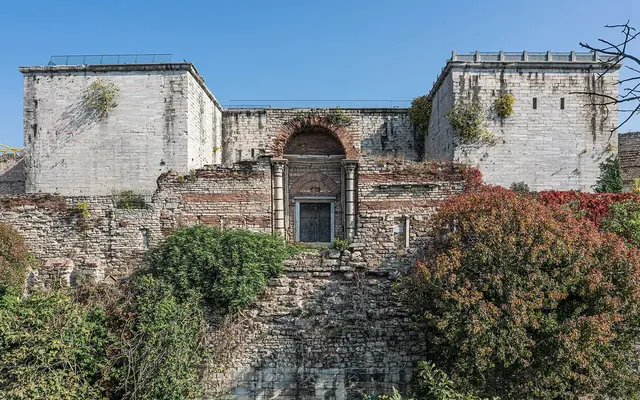
The oldest part of the fortress is the Golden Gate, a triple-arched triumphal arch of white marble dated to the late 4th or early 5th century; scholars still debate whether Theodosius I or Theodosius II built it. The central arch opened only for imperial victory processions, and sources describe gilded doors and statuary crowning the gate.
Its most famous moment came in 1261, when Michael VIII Palaiologos, having won the city back from the Latins, walked through it on foot behind an icon of the Virgin. The arches were later walled up, but their outlines are clear from both the courtyard and the outside of the walls.
From treasury to dungeon
Mehmed II took four Byzantine towers, including the two flanking the Golden Gate, and joined them with new inner walls and three great round towers to form a five-sided citadel: seven towers in all. In its early years it guarded part of the state treasury.
Later Yedikule became one of the empire's most feared prisons. When war was declared, the ambassadors of enemy states were often held here. Its darkest episode came in 1622, when the young Sultan Osman II, deposed in a Janissary revolt, was killed within its walls. In one tower you can still make out inscriptions and marks scratched by prisoners in several languages.
What to see inside
- The Golden Gate from inside: massive marble blocks and blocked arches; be sure to look at it from outside too.
- The ramparts: stairs lead up towers and walls, with the Marmara on one side and the land walls marching north on the other.
- The inscription tower: graffiti left by prisoners; a phone torch helps in the dim light.
- The courtyard mosque ruin: the minaret base of a small mosque built for the Ottoman garrison.
Market gardens and the Marmara shore
Just north of the fortress, the historic Yedikule market gardens stretch along the foot of the walls and in the old moat, farmed for centuries and now part of the UNESCO site. Head down to the shore to see the Marble Tower, where the land walls meet the Marmara sea walls, and follow them east along the coast.
The surrounding Yedikule and Samatya neighbourhood has a small square, bakeries and home-style cooking, and feels a world away from the crowds of Sultanahmet.
Getting there from Sareban Hotel
One of the easiest routes is the rail line running between Sirkeci and Kazlıçeşme on the old suburban tracks along the Marmara; it calls at Cankurtaran, within walking distance of the hotel, and at Yedikule. Check that it is running and how frequent services are before you go. Alternatively, take the Marmaray to Kazlıçeşme and walk to the walls.
By taxi, the coastal Kennedy Avenue is fast and scenic. After the fortress, you can follow the Theodosian Walls north on foot.
Frequently asked questions
Why is it called the Seven Towers?
Four towers belong to the Byzantine land walls and three were added by Mehmed II in 1457–1458, together forming a seven-towered inner citadel.
Was Sultan Osman II killed at Yedikule?
Yes. Deposed in the Janissary revolt of 1622, the young sultan was killed in the fortress.
Is Yedikule good for kids?
Children usually love the towers and ramparts, but the unrailed edges and steep stairs mean close supervision is essential.