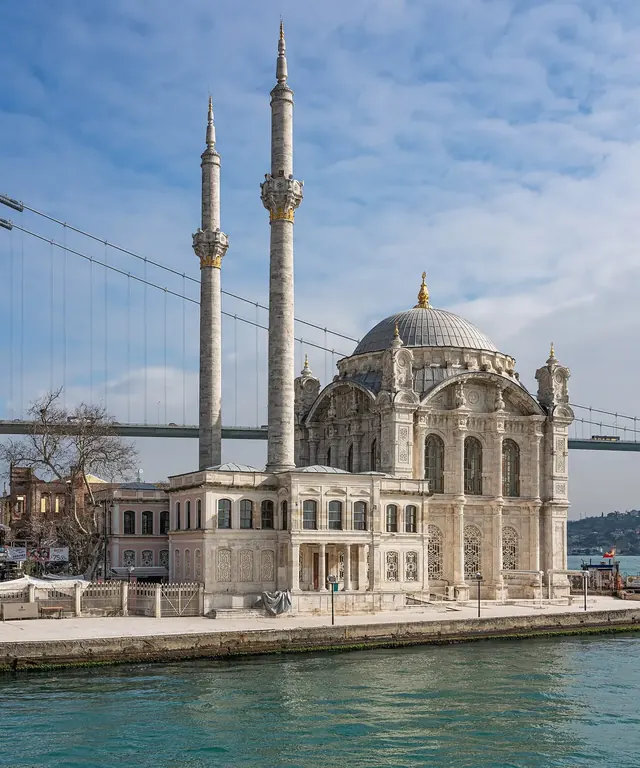
Ortaköy Mosque, officially the Büyük Mecidiye Mosque, sits right on the water's edge in Ortaköy's pier square, and together with the Bosphorus Bridge behind it forms one of Istanbul's most famous views. Built for Sultan Abdülmecid in 1853–1854 and attributed to Nigoğos Balyan, it is small, light-filled and richly decorated, and well worth a short visit.
On this page5
Sultan Abdülmecid's mosque on the water
Sources say a smaller 18th-century mosque once stood on this spot. Sultan Abdülmecid wanted a new building that would complement Dolmabahçe Palace, which was rising at the same time, and look like a jewel from the water. It was completed in 1853–1854, and its design is attributed to Nigoğos Balyan, one of the architects of Dolmabahçe, which explains the family resemblance between mosque and palace.
The mosque has been damaged and repaired several times, most notably after the earthquake of 1894. A major restoration completed in the early 2010s cleaned the stonework and revived the interior decoration, so it looks brighter today than it has in generations.
A compact building with enormous windows
Unlike the great classical Ottoman mosques, which spread out beneath cascades of half-domes, Ortaköy is a compact square hall with a single dome and two slender minarets. Carved reliefs, curving cornices and slim engaged columns on the façades mark it out as neo-baroque. Huge windows fill most of the walls and pull in light reflected off the Bosphorus, so on a sunny afternoon the prayer hall seems to glow.
On the land side is a two-storey imperial pavilion with its own entrance, where the sultan rested before joining the congregation from a private loge. According to sources, some of the calligraphic panels inside are the work of Sultan Abdülmecid himself, who was an accomplished calligrapher.
What to look for
- Mihrab and minbar: a marble prayer niche decorated with mosaic and coloured stone, and a finely worked pulpit.
- The ring of windows below the dome: stand in the centre and look up to see how the light makes the dome feel weightless.
- Calligraphy panels: look for the signature sections on the panels attributed to the sultan.
- The waterfront corner: where the mosque meets the sea, the classic shot with the bridge behind it.
- Ortaköy's layered past: a few streets from the square, a historic church and synagogue recall centuries of different communities living side by side.
Etiquette, crowds and sunsets
This is a working mosque and entry is free, though visitor entry pauses briefly during prayer times. Shoulders and knees should be covered, women should cover their hair, and shoes come off at the door; our mosque etiquette guide explains the details. As it is a small building, twenty to thirty minutes inside is plenty.
The square gets very busy at weekends, so a weekday morning is best for a calm visit. Stalls around the square sell kumpir (loaded baked potatoes) and waffles, two street snacks closely tied to Ortaköy. In the late afternoon the low sun turns the mosque and the bridge piers golden, and at dusk the illuminated mosque and bridge make one of the city's favourite evening scenes; find more spots in our sunset guide.
Getting there from Sareban Hotel
Take the T1 tram from near our hotel to Kabataş, then board one of the buses heading along the coast road towards Ortaköy and get off in the village centre. You can also walk from Kabataş via Beşiktaş and past Yıldız Park, but it is a fairly long stretch. Seeing the mosque from the water is a treat in itself: Bosphorus ferries and cruises from Eminönü pass right in front of it, as explained in our Bosphorus cruise guide.
Frequently asked questions
Is there an entrance fee for Ortaköy Mosque?
No, it is free. As a working mosque it closes briefly to visitors during prayers, and modest dress is expected.
Who designed Ortaköy Mosque?
It is attributed to Nigoğos Balyan of the Balyan family, the architects who also built Dolmabahçe Palace and shaped much of 19th-century Istanbul.
When is the best time to photograph Ortaköy Mosque?
For the classic shot from the square towards the water, the afternoon and late-afternoon sun is behind you and lights the mosque beautifully. Mornings are quieter but the mosque is backlit; after dusk, the floodlit mosque and bridge are striking too.